Showing posts with label cross. Show all posts

Friday, April 1, 2011

FRIDAY POTPOURRI: PASSIONATE ABOUT CROSSES

The Passion Cross has sharp ends on it. Of course “passion” means the life, death, and resurrection of Jesus. The sharpness of the ends of the cross recall is suffering and death, particularly the pain he endured from the nails through his hands and feet. When all four ends are thus rendered, it recalls the three nails with the longer arm representing the sword that pierced His side. According to the site Seiyaku a blunt, circular finial at the top can represent a halo of Our Lord.

Friday, March 25, 2011

FRIDAY POTPOURRI: STEP RIGHT UP

This cross I see all over the place. It is found in cemeteries and table and altar tops, particularly in certain Protestant denominations. I even owned one once. Well, a crucifix one like this. But I never knew what the three steps were at the bottom. Where they just decoration? An artistic way to keep a top heavy object from falling over?

Well, in fact it does have a name and a purpose. It is called a Calvary Cross, or stepped or altar cross. As a Calvary Cross the name makes sense since it was on Calvary that Christ was crucified. The steps going up represent the small mount that Christ climbed with His cross. Of course the steps are symbolic for the mount and the base of it, that which upon the rest is built, represents love. The step above is hope which Christ gives us in the great act of His, and the last, of course, is faith in which the Cross is planted.

Friday, March 11, 2011

FRIDAY POTPOURRI: NOTHING TO DO WITH PIRATES

Perhaps you have seen a skull and cross bones at the base of a cross or even seen in paintings as being underneath Jesus on the Cross. This stems from the legend that Adam’s bones were preserved by Noah (apparently there was a lot of cargo space on the ark) and handed down to the priest Melchisedech who eventually buried them in Golgotha, a name meaning, “Place of the skull.” Legend has it that Christ’s Cross was stood on top of that grave.

I know, I know, many of you are saying, “Really? Noah? ADAM? Do you really buy that?” Well yes and no. What it represents and is trying to get across I absolutely do. Here are the wonderful connections between the first Adam and the second Adam. The first Adam’s sin that brought death to the world and the second Adam’s obedience that brought life to the world; the first Adam’s association with a tree that condemned mankind, the second Adam’s association that brought salvation. Symbolically what a lot of wonderful information is being put forth.

Do I believe the not the truth but the factual aspect of this legend? Is it not too wonderful to believe? Is it not too miraculous that even if true, that the information should make its way to us uncorrupted? I can’t send an alter server to tell the organist in the choir loft a message without it passing through several people; the altar server who in his haste only got half of the message who told the half deaf person that only got half of that message who told the person in the choir loft that was annoyed at being interrupted and didn’t really listen and who finally whispered it to the organist who couldn’t really listen because she was playing at the time.

So suppose it is completely a made up legend. Does that change anything? Does it change theology? Does it change the message and truth of the legend? What purpose is served at having to have the legend be factual as well as true (an obsession really only observed in the modern age.) So do I believe it? I say why not. It changes nothing and is much more fun and much more freeing and inspirational than having to be scientific in this instance. I can neither prove it factual or false but see that it still brings us to truth. Science will not allow us to believe it but faith will free you to do so. So I choose yes I believe it but with just enough reserve of doubt so that if science should say, “HA! You fool! See, I have proven that it only a non-factual legend,” I can say, “Okay. Fine. Thanks. But the story is still true.”

Friday, December 10, 2010

FRIDAY POTPOURRI: THEY ARE NOT AS THEY HAVE BEEN

Occasionally one of the complaints lobbed at the Catholic Church is that she uses and celebrates things that were of a pagan nature. (“Were” being the operative term.) An extreme example is those who do not celebrate Christmas because the date at one time was the pagan celebration of the winter solstice. But as I was recently reminded at one time even the Cross was a pagan tool and symbol and now is the most central of Christian symbols.

The Christmas wreath was once too an ancient pagan symbol. In fact, our choices of symbols and dates are rather finite in this world and I bet you could find a pagan equivalent for just about every Christian one. The wreath once symbolized everything from the petition for the spring weather to return to an honor to the sun god. Evergreen and olive branches symbolize life and immortality. These too have been baptized into the Christian symbolic dictionary.

One way this happens is seeing the wreath placed at center of the Cross. Because evergreens symbolize immortality they are often placed either alone or at the cross beams of the Cross at graves. Readily associated with Christmas the wreath prepares us for the coming of Christ . Often interspersed with holy leaves the sharp edges look forward to the crown of thorns that He would wear and the red berries the blood that He would spill thereby encompassing much of the salvific actions of Christ.

Friday, November 26, 2010

FRIDAY POTPOURRI: Q R S TAU U V

The Tau cross looks strikingly like the letter “T” and is in fact a letter of the Greek alphabet. It has many uses in other religions as well as science but in Christianity has come to be a form of the Cross of Christ.

Sometimes it is called the “anticipatory cross” because in the Old Testament (Ezekiel 9:4) those who were mourning were told to mark their foreheads with this sign. Interestingly enough we do the same thing today on Ash Wednesday. So it is seen as an early echo of future events, a shadow of the Cross and the Passion to come though unknowingly. Thus is it often used in advent which we soon embark upon.

Saint Anthony used this Cross in his ministry and so it also carried the name, “St. Anthony’s Cross,” but it is St. Francis that makes it so popular with us today. He adopted this Cross on his own personal coat of arms and from there it was adopted by the whole Franciscan order. St. Francis noted that when a monk spread out his arms, his habit formed this symbol and as such they were to where the Cross of Christ always in their ministry.

You may notice that many Franciscan rosaries have this Tau instead of a crucifix. One is to mark it as belonging to someone devoted to Christ through following the way of St. Francis, the other, in part, is to picture oneself on the cross, dying to this world, joining your suffering to Christ, and looking forward to living with Him forever in heaven.

Friday, November 19, 2010

FRIDAY POTPOURRI: AT CROSS PURPOSES

I will admit that I never even heard of this cross before. I found it accidentally while looking at the site Seiyaku.com. Known as the Paternoster Cross (or Our Father.) Quoting the site, “Such a cross has been found on the walls of ancient Roman villas, with the letters A and O being the Latin equivalents for the Greek Α (alpha) and Ω (omega) terminating each arm showing Jesus to be the beginning and end, i.e. eternally divine.”

Using the beads of the Cross one starts with the large centre bead and prays the Our Father. The subsequent 10 beads one prays the Hail Marys as one contemplates the significant events of Salvation History and the life, death, and resurrection of our Lord. Therein is the nice tie-in with the mystery of the Cross.


IN OTHER NEWS:


Check the Chesterton site (click on the picture to the right) for meeting updates.


Anybody else as dissappointed as I am at the hype over Bishop Lennon on FOX news last night?

Friday, November 12, 2010

FRIDAY POTPOURRI: TAKE TWO ON A THEME

The engrailed cross is a cross with scalloped edges that gives the impression of spikes or thorns. According to the site seiyako, “The word engrailed is distantly related to grill, implying protection. (Actually, grill is not such a neat analogy for Christians, since although a grill can protect something precious, the precious gift of salvation is not locked away but freely available. Indeed, the cross can make us free.)”

But there is another way to understand this protection. It is not the Cross or salvation that is being protected, but is itself invincible and thereby this cross protects us. It is a grill for the Christian, not for itself.

The thorns also make an intriguing connection to the thorn of crown that Christ wore during His Passion. Thus two objects that were intended to humiliate Christ (the Cross and the crown of thorns) are transformed into something magnificent – the Cross becomes the Tree of Life and the crown of thorns becomes the crown of glory. Perhaps a more common and better symbol of this was last week’s Cross and crown.

Friday, November 5, 2010

FRIDAY POTPOURRI:

When you see this symbol of the cross and crown the meaning might seem simple and indeed most of the time it is. Found in stained glass windows, tapestries, and reliefs in many churches it not only represents the Passion of Jesus, but also his victory over the cross, the crown of thorns being substituted for the victor’s crown. He is Christ the King. He earned is hard won victory. “Bring forth the royal diadem,” goes the hymn, “and crown Him Lord of all!”

That being said, just because you see a cross and crown does not mean that what it marks has a connection to a Church or even Christianity so context is important. According to the site Seiyaku, “the symbol is not exclusively Christian - it is also used by the Freemasons, and from there became a logo for both the Christian Scientists and the Jehovah's Witnesses.”

Friday, October 29, 2010

FRIDAY POTPOURRI: MORE CROSSES TO BEAR

There are more Catholics in the world than Roman Catholics. There are a number of Churches of the east in full union with Rome one of which being the Maronites. St. Maron lived the ascetic life and others came to follow his way of life. They were persecuted and took refuge in the mountains of Lebanon. The association with Lebanon remains to this day and in fact there are a few Maronite parishes in the Diocese of Cleveland with at least a good portion of their congregations of Lebanese background. This cross is most associated with this part of the Church.

The three cross bars represent the “INRI” proclamation, the cross bar on which our Savior’s hands were nailed, and even though it is squished up high and is proportionately unusually long is the “foot rest.” Other symbolism suggests that they represent the Trinity as well as the union of bishops, patriarchs, and the pope.

Friday, October 15, 2010

FRIDAY POTPOURRI: HERE'S A STORY ABOUT ONE PATRIARCH AND TWO BARS

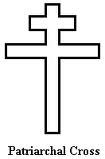
Similar to last week’s cross is the patriarchal cross. This cross is seen on the coats of arms of Eastern Rite Catholic patriarchs (bishops) and Orthodox patriarchs. This cross has two cross beams; the traditional one that we associate with the Cross and a shorter one nearer the top. There is actually some controversy about what exactly the upper beam represents.

You might be inclined to think it represents the plaque that Pilate inscribed and had nailed to the Cross. That is certainly one of the options. Others suggest that while the lower beams symbolizes Christ’s first visit to earth the second anticipates His Second Coming.

But it is interesting that this particular Cross was used in a patriarch’s coat of arms. “A third view,” reports the site seiyaku.com, “is that the first beam symbolises secular power and the second beam the ecclesiastic power of Byzantine emperors. In the 9th century, this was a political symbol used by Byzantine clerks and missionaries.” While in the west one would see what we consider a typcial processional cross behind the coat of arms of a bishop, behind the coat of arms of a patriarch one finds this cross.

Friday, October 8, 2010

FRIDAY POTPOURRI: AS OPPOSED TO UNORTHODOX CROSSES

The Eastern Orthodox Cross (a.k.a. the Byzantine, Greek Orthodox, Macedonian, Russian, Slavic, Slavonic or Ukraine Cross) is a cross with what appear to be three cross beams on them. Starting from the top we encounter a short cross beam that is in reality a representation of the proclamation attached to the top of Christ’s Cross often symbolized by the initials INRI; IESVS NAZARENVS REX IVDAEORVM, or Jesus the Nazarene, King of the Jews. The middle beam is crossbeam upon which Jesus’ arms were nailed.

The bottom beam is the one that is the most exotic I suppose for people only used to western depictions of the Cross. Though there is no reliable historical support for the practice, many of our depictions of Christ upon the Cross show a small pedestal upon which His feet were nailed. This would help support the weight of the body extending the agony on the cross. If you ever noticed John Paul II’s cross there is no depiction of this “step” which causes His legs to splay outward unlike more popular depictions of the crucifixion.

What makes this cross beam unusual however is that it most often appears at a slant. There are a number of explanations for this. One is a tradition that when Jesus took His last breath this cross bar broke thus slanting it. Another says that it acts as a kind of scale of justice. The repentant thief that was crucified with Jesus went to heaven while the unrepentant went to hell. The Cross then stands as the scale of judgment by which all will be judged at the end times. Lastly it might (or also) represent part of St. Andrew’s Cross (talked about last week) who introduced the faith to the areas from which this cross comes.

Friday, October 1, 2010

FRIDAY POTPOURRI: X-TRA CROSSES

Survey says: X

Or so it went on Family Feud. (Is that still on?) But aside from wrong answers, making the spot on a map, or substituting for a illiterate’s signature on a deed signing over the farm, the cross in the shape of an X is also known as Saint Andrew’s Cross.

Like Saint Peter, Saint Andrew felt that he was not worthy of being crucified in the same manner as Our Lord and so requested this manner of execution. The “X” shaped cross is a symbol of his martyrdom, his humility, his love of Christ, and his witness to the world.

Friday, September 24, 2010

FRIDAY POTPOURRI: HEAD OVER HEALS IN LOVE WITH JESUS

I remember once watching the “X Files” (yes I watched that show almost religiously hoping against all hope that it was actually leading somewhere) when Mulder and Dana came across a building covered in crosses that were all upside down. They assumed, wrongly they would soon discover, that the place had been inhabited by Satanists. Not a poor assumption since this cross is sometimes known as Satan’s cross. Though it is occasionally used by Satanists to mock Christian belief owing to it pointing downward to hell it is, as the website seiyaku put it, a bit of a misnomer since “’Hell is not is not physically ‘down’ any more than heaven is ‘up.’ And secondly, Satan was not crucified. That would be crucifiction.” (I thought that was clever.)

What Mulder and Dana actually encountered was a Christian cult dedicated to Saint Peter. As you may recall, Saint Peter, though condemned to be crucified, considered himself unworthy to die in the same fashion as Our Savior. So by his request he was crucified upside down, his arms stretch out near the ground and his feet fastened to the cross above. This cross then symbolizes to us the martyrdom of St. Peter and his “incredible display of humility.”

Friday, September 17, 2010

FRIDAY POTPOURRI: ALL FIRED UP

Saint Florian was a high ranking officer in the Roman army. One of his main duties was organizing fire brigades. Part of his legend states that he once saved an entire town from a fire with prayer and a single bucket of water. When it was discovered that he was a Christian he was burned at the stake. Saint Florian subsequently became the patron saint of fire fighters.

St. Florian’s cross is very similar to the Maltese cross. The main difference is that the ends of the arms bulge outwardly. This cross most associated with firefighters coats of arms. According to seiyaku.com the eight points for firefighters represent tact and discretion; loyalty and commitment; dexterity and mental adroitness; observation, attentiveness and perceptiveness; sympathy, compassion and sharing; explicitness and thoroughness; gallantry; and perseverance.

Friday, September 10, 2010

FRIDAY PORPOURRI: THE CROSS OF REJUVENATION

The Maltese Cross should start looking familiar to those who have been following this series. It s base is the Greek Cross and since the arms of the cross flair out it reminds us a bit of the Cross Pattee from last week. The difference here is that the center of the ends of the arms point back toward the center forming eight points.

This cross was first used by Christian warriors known as the Knights Hospitaller or Knights of Malta and is roughly based on the cross used by the Crusaders. The eight points stand for loyalty, generosity, piety, bravery, glory and honor, contempt of death, care for the poor and sick, respect for the Church. They can also represent the Beatitudes. Eight is also the symbolic number for baptism since after eight days after entering into Jerusalem Christ ascended into heaven. This is why so many baptismal fonts or rooms have eight sides. Hence this cross is also known as the Rejuvenation Cross because of its eight sides.

Next: St. Florian’s Cross

Friday, September 3, 2010

FRIDAY POTPOURRI: PAUSE BEFORE THE PAWS

Another cross often constructed along the same lines as the Greek cross but not necessarily so is the cross pattee - as it is known in heraldic circles though when connected with Christianity if usually referred to as the Maltese Cross, Crusader’s Cross or Cross of Saint John. In essence this cross simply means that the arms of the cross are thicker at the end than they are at the center and that can be accomplished in many different ways. “Pattee” is from the French meaning “paw,” the paws or ends of the cross splaying outward like a paw.

The cross is often associated with the Crusades usually appearing red on a white background though it was never named as the official cross, any number of crosses being employed by the Crusaders.

If you want to know if a book, such as a book on theology or a Bible, is consistent with Catholic teaching, you might turn to one of the title pages to see if it has been granted in imprimatur (let it be printed). This cross precedes the bishop’s name that has the book reviewed and given permission for it to be printed with the Church’s official approval. This cross is also often employed to mark Christian sites on a map.

Next time: The Maltese Cross.

Friday, August 27, 2010

FRIDAY POTPOURRI: WHEN PEOPLE A THOUSAND YEARS FROM NOW READ OUR TEXT MESSAGES, WILL THEY HAVE ANY IDEA WHAT WE WERE SAYING?

At my first assignment we had a weekend associate who helped us with the busy Mass schedule by the name of Fr. Gary Hoover OSB from the Benedictine Abby of St. Andrew (home of champions.) One day somebody brought in a Benedictine medal to be blessed, which they wanted blessed by a Benedictine priest (though any priest is permitted to give the blessing.)

The whole medal is used as a prayer to ward off the temptations of the devil. If you would like a full description and history of the medal you might want to look here or here.

On the back side of the medal is the Benedictine cross (Benedict means blessed and the medal as well as the people in this order are named after Saint Benedict) or Fleurie Cross. Once again we see the use of the Greek cross as its base. Like the Conqueror’s Cross from last week we find letters in the four quadrants of the cross, “C S P B.” These four letters stand for, “Crux Sancti Patris Benedicti” or “the Cross of our holy father Benedict.”

There is an interesting story about the rest of the letters. On the cross itself we see the letters, “C S S M L” and “N D M S D.” Surrounding the cross are the letters, “V R S N S M V S M Q L I V B.” As it turns out the meaning of these letters had been forgotten for hundreds of years! But in 1415 an old (old even in that day) manuscript was found giving us the key to what these letters meant. (Can you imagine being that monk that discovered the secret to the mystery? I bet he got extra grog that night!) Anyway, the letters on the cross stand for, “Crux Sacra Sit Mihi Lux” or "May the Holy Cross be my light,” and “Non Draco Sit Mihi Dux” or “Let not the dragon be my guide.” The rest of the letters are a prayer used while making the sign of the cross while making a petition to be protected from temptation, “Vade Retro Satana, Nunquam Suade Mihi Vana - Sunt Mala Quae Libas, Ipse Venena Bibas” or “Begone, Satan! Do not suggest to me your vanities - evil are the things you propose, drink your own poison.”

Friday, August 20, 2010

FRIDAY POTPOURRI - AND THE WINNER IS . . .

This is another commonly seen Greek Cross known as the IC XC cross or the conqueror’s cross. IC is the first and last letter of the word for Jesus (Ihcuc) – the c and s being interchangeable letters when transcribing the word into English – and XC are the first and last letters for Christ (Xpictoc). NIKA is Greek for conqueror therefore, combined with the cross, the instrument through which Christ conquered death, we have Jesus Christ, Conqueror!
If you enjoyed at all last Wednesday's post (see here), do yourself a favor and give a visit to Sancte Pater! They are crazy over there!

Friday, August 13, 2010

FRIDAY POTPOURRI - CROSSES ON CRUSADE

This cross is called the Jerusalem Cross or the Crusader’s Cross. From last week you will notice that it is constructed using Greek Crosses. It was given to the Crusader’s by Pope Urban II as they began their campaign to reestablish a Christian presence in the Holy Land. As the Jerusalem Cross it came to represent the Latin Kingdom that was established there.

There is no absolute agreement on what all of the Crosses mean. Most of the time the center, large cross represents Jesus. The four small crosses can represent the four Gospels, or the four directions that the Word of Christ was to spread out into the world from Latin Jerusalem. The number 5 is symbolic of the five wounds of Christ and so taken together some suggest that the crosses represent the wounds of Christ.

At other times this cross is used by travelers on pilgrimages. The center cross represents the pilgrim while the smaller crosses represent those praying for the pilgrim.

Friday, August 6, 2010

FRIDAY POTPOURRI: HAVING THIS CROSS IS A PLUS

The Greek Cross (as it appears on the Greek flag) also known as St. George’s cross is the basis for several other crosses. It does not so much represent the Passion of Christ as it does the Church. It is made of two lines of equal length dissected in the middle like a plus sign. (+)

It is used as a symbol on many nations’ flags. As with Greek flag, it denotes a connection with the Church, and as is the case with Greece, a very long association with the Church. The original floor plan of Saint Peter Basilica by Donato Bramante was to be an enormous Greek cross but it was changed to appear more like the common Latin cross.