Showing posts with label Rectorys. Show all posts

Friday, November 2, 2018

FRIDAY POTPOURRI: HISTORY OF THE RECTORY - RECOVERING ROOMS

One of the most interesting spaces in the house is a room that runs along the back of the garages, a half flight of stairs down from the main hallway It is about ten feet wide and forty feet long.  Two walls are solid brick and the other two broken up by a series of six, floor to ceiling arches of screened windows that look out on to the park across the street.  The ceiling is of dark timber with two copper light fixtures (another having gone missing and been replaced with a ghastly security light) and, at the time of this part of the story, it had a floor covered with Astroturf and the space packed with boxes and furniture.  It was a storage room.  The potential and desirability of the room was immediately evident and space was found to store the boxes and furniture elsewhere, patio furniture was excavated from out of the garage and re-commissioned, a tapestry from a local thrift shop was tacked to the wall, and plants and some old decommissioned candle sticks gave the room the final touches.  It easily became one of the favorite rooms to hang out in.


My sister was the first to voice her disapproval of the word “porch” for this space.  Remember that our experience of a porch was the newspaper stoop.  This room was too nice a space simply to be called a porch or breezeway.  A contest was launched to find a better word for this space but they all felt just as bland or definitionally deficient.  Then one day, in the record’s room in the basement of the rectory, trying to put some organization to the blueprints of all of the parish buildings, from the floor plan for the rectory a new word was added to my vocabulary.  Written in the architect’s hand where the room struggling for a name was to be found, was the word “loggia.”


As it turns out, a loggia is an open sided, roofed gallery that runs along the front of a building.  This is exactly what this room was before a second story was plopped on top of it.  All being satisfied with the word, from then on we retreated to the “loggia.”  (It was about a month into using this word that my architect brother in law pointed out that the “g”s in the word loggia were soft.  Ooops.)

Wednesday, October 17, 2018

FRIDAY POTPOURRI: HISTORY OF THE RECTORY - IT ALL SOUNDS RATHER FISHY

Still there is some call for someone to cook.  I do not mind cooking but know that I won’t.  A busy day will lead right up to the supper hour and evening appointments follow.  There is time in there for prayer and eating but not much for just being quiet for spell.  So I know, from experience, that I will not cook.  In my younger days I would sacrifice eating.  Today, I would subsist entirely on salami sandwiches with tons of mayo.  So food is still arranged.

The former pastor gathered a team of cooks who volunteered to make dinner for the rectory four days a week headed up by a team captain who served as rectory cook for special occasions.  Fr. Karg set a meeting with the captain of the kitchen one day before handing over the reigns of the parish.  When she walked into the kitchen I cried out, “Cathy!” and threw her a hug.  We had been great friends in college and had sort of lost track of each other.  Fate would throw us back together at St. Sebastian.

After catching up, we discussed dietary needs.  I am really quite easy to feed.  The only requirement was no fish.  Nothing that comes out of the water.  Every time I mentioned this people would laugh much to my confusion,   Cathy finally told me that the reason was that the former pastor would only eat fish.  

“Please tell people I am allergic to fish,” I told her.  I could not bear another round of, “Oh!  But you have not tired MY fish.”  Then comes the inevitable, “But it doesn’t taste like fish,” or “It doesn’t smell fishy.”  I don’t care.  Really.  And, pardon my rambling, why would it be better if it neither smelled nor tasted like fish?  Why not just not have fish then?  Would I be proud of my beef in the same way?  No.  I WANT my beef to both smell and taste like beef.  So why would I want to eat something only if it doesn’t seem fully what it is.  

I know, you fish lovers out there, I don’t understand.  Fine.  I accept that.  But let us be absolutely clear:  If my cow falls into the water before it is made into a burger I won’t eat it.

This is the story of the very last time I ate fish:  In my second assignment a pleasant young couple moved to the neighborhood and asked me over for dinner and to bless their new house.  We ate dinner in community at that assignment so I said that I couldn't come over for dinner but I would come over for desert and to bless the house.  So on the appointed night, after eating dinner, I headed out.  It was a dark rainy night.  It was odd because it seemed like the rain was washing what little light there was out of the sky.

Then I turned down their street which was the darkest street on the that dark night.  Their house was the darkest house on the darkest street on that darkest night.  No kidding.  In fact, I thought they may not be home.  I found out why their house was so dark when I walked up to the door: all the windows were covered with plywood.

They were, in fact, home however and graciously invited me in.  We sat in the living room which, besides the couch and a chair, was still largely boxes.  After a few minutes of chatting it became apparent that they were making dinner and expecting me to eat (again) before the blessing.  The lady of the house stood and proclaimed with much pride and joy that we were having some sort of rare and expensive thing out of the water that they would NEVER have on their own because it was so expensive.  This was a treat for them (in treating me.)

To make a long story short (too late) we sat down to dinner and began to eat.  I tried to take the TINIEST bit of the gourmet fish food and the scoop it up with as much rice as I could manage and eat.  Then I would try to get by talking (thereby avoiding eating) but my hosts had impeccable manners and would stop eating if I stopped eating.

Finally I said, "OH!  I am STUFFED!"  "But Father," they said, "You barely ate your fish!"  "Oh, you know," I replied, "I eat like a bird."  (A bird that doesn't eat fish.)

So they packed up my meal to enjoy later.  And I did come back to it later.  Or rather it came back to me.  All night long.  Over and over again.  

And thus is the story of the very last time I voluntarily at fish.

Friday, October 5, 2018

FRIDAY POTPOURRI: HISTORY OF THE RECTORY: DINNING IN

One of the most interesting discoveries was made when the industrial coffee machine, declared to be in the wrong place, was moved to the other side of the kitchen.  Behind it on the counter was a space in the wall about two feet square and one foot deep.  There were keys, one a skeleton key, hanging on a hook so covered with dust that it was obvious they had not seen use for some time.  The back of the space was a little door with a handle on it that opened out into the dining room, the purpose of which was explained to us during a visit with a priest who had been assigned in the hay day of the parish with Monsignor Zwilser.

The dining room, with its birch wood paneled walls, simple plaster crown molding, chandelier, and built in china cabinets, originally consisted of two rooms, the larger formal dining room and a much smaller room between it and the kitchen, set off by a proscenium arch.  The smaller of the rooms was once a smaller dining room.  After the new church was built and a hallway from the rectory to the sacristy was created, the window in the small dining room was made into a door and this little room became nothing more than an intersection between the church, rectory dining room and kitchen.  We stuck a studio piano and pump organ in the space a dubbed it the music room.  The organ was given to me many years before I became a priest by a college that wanted to continue my services for another couple of weeks and had run out of funds to pay me.  In exchange for the organ I stayed on and it has been following me ever since.


The smaller dining room was separated from the main dining room by a thick, velvet curtain that hung in the arch.  Monsignor ate at the long table in the main room alone.  Behind the curtain were the parochial vicars at their more humble table.  Before the parkay floor was added there was a floor buzzer by Monsignor’s seat.  When he had finished a course he would press in the buzzer with his foot and the little door would open in the small dining room with the next course.  One of the priests would take it and pass through the velvet curtain, exchange the next course for the empty plate, return it through the window at which time the rest of the priests would receive their meals; priests and cooks never passing between the two worlds separated by the swinging butler’s door until the room was vacated.


Things are of course much different today, residents tramping between the two rooms cooking, setting up, and eating with no bells to mark the end of a course.  The age of live-in help passed away mostly due to the advent of Social Security.  A woman of a certain age at one time may have found herself in a difficult spot or she may have found herself plain board.  Back in the day, living in at the rectory and taking care of the helpless, vowed bachelors might provide her income, a place to live, and company to manage.  It is almost unheard of today.

Friday, September 28, 2018

FRIDAY POTPOURRI: HISTORY OF THE RECTORY CHAPTER THE FOURTH: TAMING THE KITCHEN

My family came over to help me break in the new house.  Mother and Father having passed, the task was left to my sister Mickie, my cousin Bernadette, and my Aunt Mary.  All setting off to explore and snoop we became separated from each other.  The house is large but not that large.  But the privacy walls erected in hallways made parts of the house isolated and the floor plan confusing.  We became sufficiently lost in the unfamiliar surroundings and had to use cell phones to be brought together.  The reunion was reminiscent of characters in a haunted house movie finally coming together after having gone their separate ways for some inexplicable reason.  Together after our adventures, it was decided that it was time to break in the kitchen.

My family considers this room one of the most important to a priest.  When I was first ordained my cousin Bernie bought me a cookbook with the admonition, “You are now becoming a public figure.  The only place people cannot tell you what to do is in the bedroom and in the kitchen.  Learn how to cook.”

In general people either love this kitchen or they hate it.  There is very little middle ground.  It is large, high ceilinged with tile floors, and a butcher block table right in the middle.  I am somewhat naive when it comes to kitchens but was rather taken in with its dual microwaves.  The assembled family fell on the positive side concerning the kitchen.

It is located in what is called the service corridor of the house.  This section of the house also contains the live-in’s bedrooms, which had been transformed into offices, the live-in’s living room now serving as the breakfast and lunch room, and a private staircase which givES access to the priest’s quarters upstairs and the  laundry room, boiler room and storage/pantry downstairs.


The first job was simply trying to figure where everything was.  Here I was gently pushed aside as the new order was taking shape.  “Spatulas!  These belong by the oven!  Knives!  These belong by the butcher’s table!  These pots and pans need to be handy!  These can go under the counter!”  And so the kitchen quickly took shape and my relatives did it with such authority that I have been afraid to change it to this very day.

Friday, September 21, 2018

FRIDAY POTPOURRI: HISTORY OF THE RECTORY: IT'S A DOG'S LIFE (END OF CHAPTER 3)

The next cause for concern was (the dog's) name.  Upon hearing the name “Roomie” people’s first reaction was always first, “Oh . . .” followed by as polite an, “Eww,” as they could muster.  First impressions of the name always turned to rheumatoid arthritis or rheumy eyes.   Explaining the name helped.  The dog was thought to be a companion for a person who was somewhat bedridden and he had named him Roomie as in, “This is my roommate – Roomie.”  But explaining this became old quickly and it did not mitigate the problem that still nobody liked the name.  But what name did fit him?  Days were spent thinking about it.  This led me to believe that I would not make a fit dad.  My child would be 15 before I came up with a name; the quick finding of names of things not coming naturally to me.

Our mother parish, St. Vincent, right next door and the oldest parish in the city, came to the rescue.  The pastor there had a dog, who regularly “wrote” an article in the parish bulletin.  He was named Vinnie after the patron saint of the parish.  With the precedent set, Roomie, the dog of the newest parish within the city limits, would now be named Sebastian.

I will be the first to admit that Sebastian is an awfully pretentious name for a dog and a nickname was eagerly sought.  One day, shortly after his christening with his new name, a delivery man came to the door and took obvious delight in the dog.  “What is his name?”  he asked petting him on the head.  Upon being informed that it was Sebastian he exclaimed, “Why that was me Pa’s name!”  Quite intrigued we eagerly asked if his father was ever given any kind of nickname.  “Sure he was,” said the delivery man.  Excited to find out what Sebastian’s new nickname might be he was asked what his father was called.  “Busty!” was the proud answer.

How they got “Busty” out of “Sebastian” is beyond me.  In any event, Sebastian was not going to be called “Busty.”  It seems inappropriate for a rectory dog of expected high morals.  So for the most part he remains Sebastian though there are a few other nicknames to which he will readily answer: Poops, Sea Bass (my least favorite), Bosco (I don’t know why) Seraphim (long story) and a host of other names – but mostly he is just Sebastian.
Now after everyone went home at night there was something living in the house that could tell me if I should be concerned about a noise, that would alert me if I should miss the doorbell, and could divine which of the doors it was that needed answering without me running to the four corners of the house.  It was a joy having a house mate.


I needn’t have worried about being alone however.  A little patience would have revealed that the rectory was destined to be full of residents.  And they were all welcome.  As long as they liked dogs.

Friday, September 14, 2018

FRIDAY POTPOURRI: HISTORY OF THE RECTORY: THE FIRST BOARDER CONTINUED

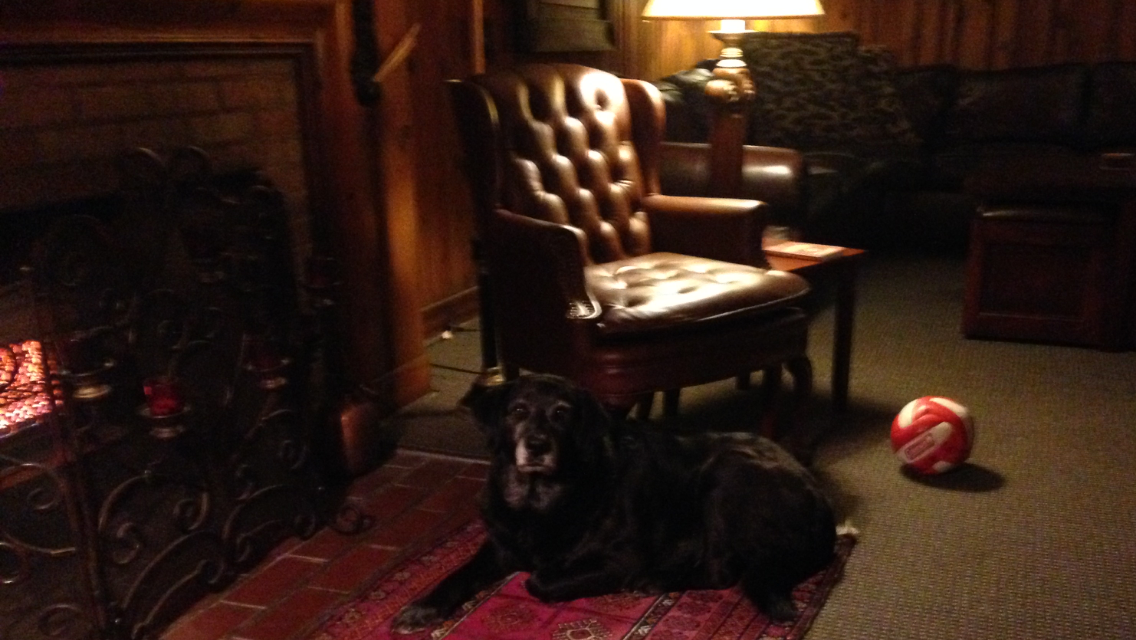
The dog came for his interview the following Monday morning.  He looked like a black lab save that he was a little larger, hairier, and with a longer snout.  And had a heart the size of a full moon.  On one hand this was very endearing.  On the other it made him go into an anxiety fit when it was apparent his owners were leaving without him.  He threw himself against the door with the fervor of a man who was wrongly accused of a crime being thrown into solitary confinement for the rest of his life.  The old curtains on the door windows were shredded.  It was time to replace them anyway.

It took the better part of a day to coax the dog out of a deep depression.  Not even food tempted him and at dinner I had to hold morsels of dog food up to his snout for him to mindlessly eat as he stared out the backdoor.  At some point however something clicked and he simply decided to make the best of a stressful situation.  I tried not to form a bond with the dog.  What if the staff would say that it was too difficult to have a dog in the house?  But he was extremely affectionate and turned on the charm full steam and within hours I was in love.

So we move into his first night at the rectory.  Some dog book warned against ever letting a dog sleep in your bed.  “You will come home one day and all your bedding will be chewed up!” it warned with great foreboding.  When I went to bed, the dog came rested his chin on the edge of the mattress and looked at me with his big, black, watery eyes.  I was strong however.  If we were going to do this we were going to do it right.  Besides, I had never slept with any living being in my bed and was not sure that I could start sharing it now.

The dog decided to settle for sleeping under my bed which was not a good move since he was a large dog.  As he crawled under or tried to turn over it was like being in a commercial airplane with a little kid kicking the back of my seat.  A couple of days later he settling on sleeping in the very back of the closet where there was a little private hideaway formed by my hanging cassocks.  

Over the week, the dog, whose name was Roomie, and I became inseparable.  He was a constantly glued to my side whether I was going into the office, my room, down in the basement, or anywhere for that matter.  I soon discovered that walking him with a leash was rather redundant.  Save for the occasional squirrel, he was not going anywhere without me, though I drew the line at the bathroom.

He did not come with any toys and so I dug around in one of my trunks and found old blue racquetball balls.  After dinner when the staff had gone home, we would go to one of the long hallways in the house and I would chuck the ball with the dog in hot pursuit.  Being that the ball had a lot of spring in it, it would bounce in any number of unpredictable directions and Roomie would do his best to try to subdue the thing before bringing it back for another go.  It was quickly apparent that the dog had no athletic prowess at all (and would never develop it.)  But he did have a lot of gumption and so kept at it.

The week passed quickly and the owners of the dog returned to take the dog home for the weekend and wait for a decision.  Everyone had the intervening couple of days of the weekend to decide if a dog, let alone this dog, would be a good fit for the parish.


By Tuesday morning the dog was permanently installed in the house, the staff later informing me that they knew the dog was going to be a resident fifteen minutes after his arrival.  They saw the bond fixed and made permanent that first day.

Friday, September 7, 2018

FRIDAY POTPOURRI: THE RECTORY: CHAPTER III

What are you going to do with these empty rooms now?” asked the business manager about the vacated bedrooms on the top floor.

“I want to make them into nice suites and lure priests to come to St. Sebastian.”  Being alone at the parish I hoped we might find a couple of retired priests that would like to take up residence.  Or maybe one of the priests from the seminary would like to become a weekend associate and help with Masses and confessions and stay on for dinner and conversation.  Maybe a foreign priest studying at the University would need a place to stay.  In any event, if that was to happen, we would first need fitting quarters and so plans were set in motion to start creating desirable living spaces out of what had served as offices.

In general, it seems to me a good thing for parishes that can to have more than one priest to serve them.  It is certainly no secret that one size does not fit all in this world and the same holds true when it comes to priests.  Having more priests around at St. Sebastian would up the odds that someone not finding me their cup of tea would have a better matched spiritual guide and companion.  

Then there is the selfish reason of having another priest to talk to in the evenings.  My previous parishes always had at least three priests to discuss the day’s events with.  And to be quite honest, there are some things that one should only speak about with other priests.  It is also nice just to have something else alive in the house besides a fern with which to watch the game on T.V. or with whom to go to parish functions.  But after five o’clock, everybody left and the rectory, and that, which felt cramped and loud during the day, seemed expansive and lonely at night.

The first resident would show up a few weeks into my assignment.  The business manager came into my office and asked, “Father, what do you think about a dog?”  I tried to hide my eagerness and cautiously asked, “Why do you ask?”

“Well, my sister has a several dogs and cats and they are moving.  They have a new dog, a golden retriever and black lab mix that they can no longer care for.  Father, it’s a great dog and if I can’t find a home for it, they are going to take it to the pound.”


After a bit of feigned hemming and hawing I agreed to an interview.  The dog would visit for one week and then would go back home.  Then there would be a staff meeting to see how everybody felt about the dog, and if everybody was Okay with it, St. Sebastian rectory would be its new home.

Friday, August 24, 2018

FRIDAY POTPOURRI: HISTORY OF THE RECTORY: MAKE ROOM FOR A NEW PARTNER

The next part of the project was that of changing the copy room into an office in order to get all of the offices off of the bedroom floor.  Thee is just something creepy and inappropriate about taking a shower and getting dressed in your bedroom while in the very next room someone is meeting with a bereft parishioner.  

The first move would need to be the evicting of the copy machine out of its own office in order to free up some space.  It turns out that if the copy machine were a person it would be appreciated for its efficiency and hard work, but nobody would want to partner with him because he took up  lot of space and was smelly and noisy.  Conversely, nobody wanted to be too far away from him.  Put him in the secretary’s office?  He was too noisy and it was already too packed in there.  The basement?  Too far away and too damp.  The hallway?  Too small and there were no available outlets.  The volunteer office?  Move over and make room for your large, smelly, loud new partner.

With this space and some other creative adjustments in the house, all of the offices were moved out of the bedroom hallway.  A little ground had been claimed for house!  That would not be the end game for the little office in the front of the house.  Before things really settled there would be a few more moves but by and large the staff was amiable about their relocations.  It turns out they were uncomfortable having offices amongst the bedrooms also.


Interestingly enough, the change in status of the rooms altered our taxes.  Every square foot of the house needs to be accounted for.  Having offices turned back into living space means a slight loss of a tax break for the Church.  But hopefully the investment in sanity and appropriateness would be worth it.

Friday, August 17, 2018

FRIDAY POTPOURRI: RECTORY HISTORY: STEP INTO MY OFFICE

One visits the offices by walking down a long sandstone walk boarded by flowers and azalea bushes that bloom beautifully in the spring.  Steps lead up to the arched front door of the rectory.  When I first arrived at the parish, the steel screen door was terribly rusted and a host of assorted and abandoned call boxes decorated the door frame.  One of my first official acts concerning the rectory was to clean this area up and make the house more inviting.

Everything electronic save for the doorbell was removed.  The thick, heavy wooden door was removed, sanded, stained, its hardware cleaned, and rehung.  Flags were hung on either side of the door; one the flag of the United States, the other the Vatican flag.  A priest friend who is did not approve of this touch looked at the Vatican flag and snidely comment, “What? Is the pope in residence?”  “No,” I responded dryly, “and neither is the president of the United States.”  It also makes a great marker when telling the pizza delivery guy where to drop off the pizzas.

Finding a new quality screen door was going to prove to be more difficult.  A shop was found that made special order screen doors.  The dimension were given to the man behind the counter immediately surmised, “So, you must live in West Akron.  We get a lot of strange doors from that part of town.”  Unfortunately the price he quoted was far too high to justify.  So were the doors we found through online sites.  Strangely enough, after making such a big fuss about the project, a good quality door was found at the local hardware store for a reasonable price.

The font entry was now ready.  The grounds crew had planted giant pots of flowers on either side of the door below the flags, and, at my sister’s insistence, geraniums bloomed from the cement planter at the second floor window over the door while verdant vines hung down softening the ornate stone arches. 

Just past that front door one finds himself in a small reception hall with a barreled ceiling with a dark, slightly ornate lighting fixture hanging from it.  This is the original office area and would be the first area indoors to experience my meddling.  Here, a picture of the pope, the bishop, the former pastor, and a composite of all the former parochial vicars were hung.  It was an act that felt a little exhilarating and, to be quite frank, a little sacrilegious to move the former pastor’s portrait over to where the former pastors were hung and replace the vacated space with my own image.  Finishing the job I winced at seeing my picture.  I have spent the rest of my time here studiously avoiding looking at it, the only time it requiring my attention is when a pope or a bishop changes.
     
To the right, the former pastor’s office, was now the office of the parish secretary and with her the parish records, various forms and envelopes and stationary of all kinds, an anachronistic typewriter, FAX machine, office supplies, mailboxes, and in general, anything that would not fit anywhere else.  Across the hall in what was the secretary’s office was now inhabited by the copy machine, copy paper, stapler, cutting board and all things copy machine related.  


It was announced that monies had been set aside in the previous year’s budget (before I arrived) to put drop ceilings in these rooms and that the workmen would be arriving within a week.  I probably overreacted but my abhorrence was real.  There are a few materials in modern architecture that I detest more than drop ceilings.  “Somebody call them immediately and tell them not to come!  Don’t let them anywhere near this house!  There will be no drop ceilings!”  I needn’t have been so dramatic.  They just shrugged and said, “Okay.” 

Friday, August 10, 2018

FRIDAY POTPOURRI: HISTORY OF THE ST. SEBASTIAN RECTORY: RAISING FUNDS WHEN FUNDS WERE SCARCE


The Parish of Saint Sebastian was founded in 1928.  Until 1805 the east boundary of the parish was the western boundary of the United States.  The modern day road marking this line, Portage Path Road, roughly follows the trail Native Americans once used to portaged their canoes from the Cuyahoga to the Tuscawarus river.  Doing this allowed them to travel from the Great Lakes all the way down to the Gulf of Mexico via waterways save for this relatively short stretch of land.  

The land on which the parish buildings stand were once was part of a large farm that served as the county home.  Evidence of this farm exists to this day by way of a city park located one block east of the church.  Every summer rectangles of slightly greener and quicker growing grass appear in perfect rows at one end of the park, remnants of what once served as the graveyard for residents of the county home.  The graveyard was moved when the home was moved further out into the country when the city invaded what was once nothing but farmland.  After having done some excavation to improve the flooding conditions of the park, the city declared that all of the bodies had indeed been removed.  But I don’t go walking in that park on All Hollow’s Eve at midnight just the same.  (Just kidding.)

Originally the parish was to be located about an eighth of a mile from where it now stands but anti-Catholic sentiment forced them to buy some former swamp land which, in the long run, became a much more ideal location.  God works in wondrous ways.

The first building to be built was a combination church, school, convent, parish offices, and social hall.  The pastor lived at the local Catholic hospital and served as chaplain there until he moved to a rented home a few blocks south of the rectory.  But in the mid-thirties that house was sold forcing Father Zwisler and his parochial Vicar, Father John Murphy to find another house to rent.  It was at this point that the pastor decided that it was time to build a parish rectory.

Fishing around in the parish archives, I came across some old newspapers that the parish published in 1936 concerning the campaign to build a rectory.  The masthead of the “The Local Motive” was a head on picture of a locomotive charging toward the reader and written on it it declared that the parish wanted to raise $30,000 to help erase debt and $30,000 to build the rectory.  “Give it right away!” it urged.  

From reading the various articles, it sounds as though the project was not without controversy.  The great depression was still on, the bank that held the parish’s saving had just failed and this was no small amount of money.  According to the Bureau of Labor Statistics consumer price index, $100 in 1936 equaled about $1,813 in purchasing power in 2018.  Today it would be the equivalent of raising well over a million dollars.  But it was successful and soon the rectory was constructed.

There is surprisingly little known about how the rectory originally looked interiorly.  There are no pictures of the furniture, window treatments, or wall colors.  Apparently the floors were covered in brown linoleum which still exists in some closets and under the carpeting.  The only picture of the original interior of the house of which I am aware is of two couples who were married in the pastor’s office before the young grooms were sent off to World War II.  In the upper right hand corner you can just about make out the end of a curtain rod, remarkably similar to ones found in the living room but that were only installed recently, and a bit of a curtain with flowers on it.  Not much else is known.


Despite the size of the parish and the house, it was only built with three offices; the large one for the pastor which also contains a vault, and two smaller offices, one for the secretary and one for all other priests to share.  This was not all that uncommon.  Unlike modern parishes, there were no business managers, bookkeepers, youth directors, directors of religious education, marketing directors, development directors, let alone computers, copy machines, FAXes, and a host of other large electronic equipment we cannot live without today.  Parishes were not expected to do as much, priest’s roles were a bit more limited, and so the construction of a hallway of offices would have seemed an extravagant waist.  Those three offices still function as the main offices of the parish though their use as changed.  

Friday, August 3, 2018

FRIDAY POTPOURRI: HISTORY OF THE RECTORY: CHAPTER 2

On a drizzly afternoon in June, the Knights of Columbus council at St. Sebastian came to St. Clare in Lyndhurst, about 45 minutes away and where I had served as parochial vicar for the past three years to help pack up my belonging and move me south to Akron.  St. Clare had been very good to me.  The rectory there had been recently renovated and my room was very generous.  It was one of two parishes in the diocese that still had a live-in who cooked and did laundry; Social Security and rising standards of living having all but wiped out the need for a person to find work in a rectory to make ends meet.

Though that rectory that stands out in the diocese as a very fortunate place for a priest to live, the St. Clare rectory was in the middle of the church and school parking lot as well as right off of one of the busiest roads in Cleveland: Mayfield Road.  Mayfield is one of those magical roads on which you can find just about anything you might need with the exception of quiet and easy driving.  Businesses on the East side of Cleveland gravitate to this road that stretches from Little Italy in the heart of Cleveland to the rich suburbs far out toward the rising sun.  But that also means that it is a nasty tangle of traffic most of the day and being a main thoroughfare, if an emergency vehicle is going to be called to any place, it is going to go past St. Clare on the way there with sirens screaming.  

One night, waking me from a deep sleep, the sirens made their usual racket becoming louder and louder as it neared the parish and then, at its peak, abruptly stopped instead of fading as it made its way past.  I opened my eyes to find my room awash in blue and red flashing lights.  Padding over to my window I saw a car turned over on the immaculate front lawn.  Apparently someone had thought it a good parking spot but not wanting to mess up the lawn with tire tracks decided to park it on its roof.  (Fortunately no one was hurt – or wouldn’t be until the next morning when the hangover and the clarity of what happened the night before set in.)

All the rectories that I had lived in previous to coming to live at St. Sebastian had been in the middle of a field of a tarmac parking lot.  This was particularly evident at my first parish when car alarms were finishing their first blush of being standard equipment on cars.  Gentlemen, and I use the term loosely, still thought it hysterical to wait until a female acquaintance walked by their car so they could set off the alarm from a distance and bend over laughing when the lady would screech.  Neither the women nor I, listening to it for the umpteenth time in my room, found it the least bit funny.

Privacy, then, is always at a bit of a premium.  I remember once, at St. Ambrose, I had been taking a nap, woke thirsty, and stepped out of the room to go downstairs to get a cup of water.  The door was locked to keep well intentioned persons from coming in.  After stepping out into the hall, the wind from an open window caught the door and slammed it shut locking the room up tight.  It was one of those days that I wanted desperately to have a little alone time so I snuck downstairs in my stocking feet, hair mussed (having hair then) and clothes crumpled.

I butter knife was snuck out of the kitchen and I tried to jimmy the door open.  First one person than another showed up to try to get me in my room.  Soon there was a group of about seven people offering advice on how to get the door open.  The handle was completely disassembled and still there was no gaining entrance.  I snuck away, got an extension ladder and, in front of the entire school out for recess, climbed up to my window, slid in and announced, “I’m in my room!  You can all leave now!” and then curled up on my couch to finish a nap.

Of course, having people around is also a blessing.  When John Paul II died and I was in one of my wanting to be left alone moods, I got that same ladder out and climbed to the roof of the church to hang the black mourning banners.  A strong wind came along and blew the ladder down trapping me in the roof (this was long before I owned a cell phone.)  Fortunately a kind jogger came along and heard my cries for assistance and righted the ladder.


In contrast, the rectory at St. Sebastian is located in the middle of green lawns, hemmed in by the school and the church building.  But no general parking lot comes near it.  Across the brick avenue is a park named Elm Hill Park though everyone calls it Forest Lodge which is the building that stands on its grounds.  The new building built by the WPA was named after the hunting lodge that once stood there when this part of Akron was considered way out in the country.  All in all it is about as nice a setting one could hope for while still being inside the city limits and it was this house that the truck carrying all of my worldly goods drove up to using the curving brick driveway under a canopy of oak and maple trees to the rear entrance of the rectory.

Friday, July 27, 2018

FRIDAY POTPOURRI: RECTORY HISTORY: TO EACH HIS OWN

That is not to say that the way the pastor had the rectory set up is wrong.  It was right for him.  He is of the type of gentleman that gets his energy from being around people.  My first pastor was like that.  Fr. Hilkert of St. Ambrose Parish (God rest him) loved being around people and he didn’t have a lot of boundaries.  His suite was off the first landing on the stairs and easily visible from the front offices.  It was not unusual for him (he was in his mid-80s when I was with him) to be in his pajamas by 8PM.  The secretary might phone up and say that someone stopped by to see him and, putting the phone down would holler down the steps, “Just come on up.  I’m in my chair and have no intention of getting up.”  It would be unheard of today in our litigious society to greet somebody in your pajamas but back then it was a funny quirk.  

Once, getting back to the St. Ambrose rectory late the secretary stopped me and said, “Would you please go up and see if Father is alright?  A couple of big young men stopped by to talk to a priest and he told me to send them up and they have there has been a lot of yelling coming from up there.”

I ran up the stairs, knocked, and went in.  There were two rather beefy young men with Father and they were all holding Bibles and talking over each other.  It turns out that they were Protestants and one of them was getting married to a Catholic and wanted the straight story “from the horse’s mouth” exactly what Catholic believe.  Greatly relieved I said, “Hold on, I’ll get my Bible,” and so joined in on the conversation.

In many ways, though I think we had the relationship I had with that pastor was that of Grandpa and Grandson, Fr. Hilkert and I were polar opposites.  But it was his rectory and whatever he wanted went.  That is, until he decided he was going to put a deacon’s office on the second floor where the living quarters were, directly across the hall from my bedroom.  This house was built in the ‘50s when there was no need for as many offices as a modern parish needs and so, as happened at St. Sebastian, offices crept further and further into this house until there was only one spot left un-invaded by office workers – the guest room directly across the hall from my bedroom.

Sometimes I worry that I am a little too private or picky.  But the idea of taking a shower and changing my clothes and hearing a meeting going on out in the hall with only an inch thick door separating us was more than I could bear.  So I went to Fr. Hilkert’s office, with whom never an ill word passed, and said, “This is your house, and you may do whatever you want with it and I will support you.  But I just want you to know that if you put an office across from my bedroom, I will move out.”  I said it in a very calm and matter of fact way – or at least that is the way I remember it.  There I times that I think I am being very calm about things and friends will say, “Boy, could we tell you were loaded for bear.”  I am always amazed by this.

“They aren’t gonna be coming in your room!” he grumbled back, perhaps sensing an underlying feeling of petulancy.  

“I didn’t say they were.  I am just saying that if there is an office up there, I will not be.”

“I can put offices anywhere I want to.”

“I know that.  I didn’t say you couldn’t.  I just said that I would be moving out.”  

That was the closest we had ever come to fighting in the seven years we were together.  He finally gave in and I apologized.  Looking back I know I was bull headed enough to carry out my threat but I have no idea where I would have gone.  Living in the rectory, after all, is part of our compensation.  One night in a hotel is more than a priest makes in a weekend of Masses.  And the food isn’t as good.

Priests who are extraverts are few and far between.  At least of the ones I know.  This is a good thing.  If you put 5 introverts in a room with a bowl of peanuts, come back in an hour and they all will have found something to read.  Put 5 extroverts in a room together with a bowl of peanuts, come back in an hour and at least one will have to go to the hospital to have the bowl of peanuts removed from his nostril.  So considering we end up living together in situations not far removed from arranged marriages, it is good that so many of us so inclined to some amount of passivity.

There are ways, however, in which it is far easier to be extroverted priest than one that is introverted.  One would be in the arrangements of the rectory.  It is easy to open up your house and invite everybody and their pet cat to roam through at will, dropping in on your breakfast to get a cup of coffee and make idle chatter, taking a short cut to the church when you have company, popping in at night to “get some things done” while you are sitting in the living room in sweats, eating popcorn and watching the game.  True extroverts love this.  “No!  You’re not interrupting!  Sit down and talk for a few minutes.”

Woe for the introverted priest whose assignment as pastor follows that of the extroverted priest.  While the extravert gets his energy by being around people and the more the merrier, the introvert (such as myself) gets his energy by being alone.  And we know from experience that when we try to fashion our home as is befitting an introvert after an extrovert has been there, we seem territorial and mean spirited.  Maybe we are.

So at first you try to live with it, silently crushing your newspaper when someone interrupts breakfast to catch up.  Or scuttling out of the kitchen late at night not wanting to be seen on your PJs when an unexpected visitor with keys comes in the back door to work on a project for the morning.  First we try polite explanations such as, “Could you please not come in to the rectory late at night without warning me?  Sometimes I like to come down from my bedroom for a late snack and am not dressed for visitors.”

Inevitably will come the reply, “Oh but Father, I don’t mind seeing you in your PJs.”  Which may be very true.  But the problem stems from not wanting to be seen in my PJs.  So then the introverted priest starts laying down rules such as “Nobody in the rectory after office hours!”  Maybe that’s it.  We stuff it down until we are upset and then it comes out a bit harsh.  So you feel guilty and so maybe you bake a little something and leave it on the kitchen counter to try to make up for it.  It is best to be a good baker in times like these.

*

Baking only ingratiates one for so long.  Soon the complaints of ruined diets start marring the positive effects that the initial baking created.  But there was a perennial favorite: my mother’s apple strudel.  It always appeared around the fall and would disappear like a freed helium balloon on a windy day – more of a flash of sweet memory than anything lasting.  

MOTHER VALENCHECK’S APPLE STRUDEL:
(As copied from an ancient piece of notebook paper, written in her own hand and covered with grease spots.)

¼ cup of water
3 eggs
2 Tbsps. of vinegar
2 cups flour
2 sticks of butter (½ pound)
9 (Mom always used half Macintosh and half Jonathon)
1 cup sugar
Dash of cinnamon
Dash of lemon juice
1 cup crushed cornflakes
(I add a little vanilla to the dough.)

Mix together the water, vinegar, and 3 egg yolks (& vanilla.)  (Save the whites for later.)

In another bowl, cut the butter into the flour as you for pie dough.  When the butter is “pea size” add the liquid ingredients and knead until it forms a ball and no longer sticks to the side of the bowl.  A good amount of flour may need to be added as you knead.  Let the dough sit covered in a bowl in the refrigerator for at least an hour or even overnight.

The Filling:
Peel, cut and slice the apples to a size of your taste
Add to the apples the sugar, cinnamon, lemon juice, and 1 cup crushed cornflakes.

Preheat oven between 325-350

Divide dough into four to six balls and roll out a thinly as possible into a large rectangle.
Place apples along one edge.  Place a row of cornflakes alongside.
Roll the dough, folding over the ends and sealing all with the egg whites.
Paint the rolled loaves with egg whites or melted butter, sprinkle with sugar bake for 1 hour or until golden brown.

APPLE DUMPLINGS:

Instead of slicing up the apples, peel and core depending and size, about 10 of them.  
Roll out dough into as many squares.
Place apple in the middle of the square and fill the now empty core with sugar, a dash of cinnamon, and a pad of butter at the top.
Fold the dough up and around the apple securing with the eggs whites like glue.
Coat with egg whites or butter, sprinkle with sugar and bake for 1 hour or until golden brown.

In a double boiler melt some red cinnamon candy.


Put dumplings in a bowl with ice cream and pour to cinnamon mixture over.  Serve piping hot.