Friday, September 7, 2012

FRIDAY POTPOURRI: THE WAY TO DO IT RIGHT: FIRST COMMUNION


Everyone knows exactly how First Communion should be done.  It is as obvious as the nose on your face: that is, if you are a fly looking through an eye constructed with as many lenses as a soccer ball has pieces of leather giving you the appearance of having 20 such noses.
 
People can become rather passionate about how things should be done.  At one parish at which I was assigned there were such strong opinions that we had several different First Communions (there were enough children to warrant it) so one might choose from “Class Communion” to “Family Style Communion” to “Individual Communion.”  All of them have very good reasons behind them.  (I'm in the picture to the right.)


At Mass, we are not mother, father, child, uncle, aunt, etc.  This is why one is called upon to give the sign of peace to only one person.  In shaking hands with one person one has symbolically shaken hands with all.  If you start shaking hands with everyone around you and shooting the victory sign to others across the aisle, it becomes a literal act.  So Class Communions make sense because these are individual people setting off on their next level of initiation into the Church.
 
On the other hand, going with the family may make a symbolic and practical example for the child.  “See?  We all do this together.” 
 
And finally, just showing up one Sunday and having a First Communion may train the child on how to do things for the rest of his life.
 
Of course, only one of these is the best.  But only God and a few angels knows which one for sure.  So please consider giving your DRE or second grade teacher or pastor some understanding if it is not being done exactly the way you desire it.  The focus is on receiving the Eucharist.  Everything else – everything else – is secondary.  As the inimitable Mrs. Fenner reminds us, “the child’s attitude will be formed by those of their elders.” 
 
What should a child wear to a First Communion?  Most parish/schools have their own tradition.  It would be wise to inquire what it might be at your place.  However, the most common dress in our country today would be, for the boys, dark pants and tie with white collared shirt, and a white dress with veil for girls.  Once again, taking our cue from Mrs. Fenner, “Whether you can choose a costly costume or an inexpensive one, it is always good taste to keep it simple.  This applies to the accessories also.”  (This is very different from her advice for clothing at baptism.)


To me, the girls costume makes sense.  Not so much the boys.  The Church is the bride of Christ and Jesus the bridegroom.  It makes sense that girls being introduced to Jesus in this most intimate way should be dressed in white and a veil.  But what of the boys?  Well, they are just to look smart.  They fail the symbolic test.  But get over it, now tuck in your shirt tail and straighten your tie.
 
This last part we quote directly from the book:  “In Spain and in other Catholic countries, well-to-do families have a charming custom which might well be adopted by families of mean in our own land.  (When I first read this I thought, ‘uh oh.  What?’)  A wealthy family will dress its own child in an inexpensive costume and will completely dress a poor child in the same First Communion class anonymously.  (Good luck with that.)
 
“Consult the Sister in charge of First Communion (Ha!  Times have changed) and find out if any children in it are underprivileged (are we still allowed to use that term?) and arrange with her to make a secret gift of a sum of money – enough say, to buy a pair of shoes – for one or several of these children.  Do not let the recipients or any one save for Sister (or the pastoral minister) who made the gift.
 
“Tell your child what you have done (I don’t recommend this) in her name (why ‘her?’ – I suppose a boy generally does not care if he has a less expensive tie on) and that the money was saved by buying her a simple costume, so that she may learn young that true charity, which is Christian love, is both a privilege and a personal sacrifice.  If you feel, however, your child is too young to keep such a matter secret, do not tell her about it until she is old enough to understand it.”


Thursday, September 6, 2012

THE SLAP THAT COST $250,000

Bluecoats is an organization that strives to take care of our emergency first responders who are injured in the line of duty.  I am lucky enough to be one of their chaplains.  Last night they had their annual banquet and yearly meeting.  They always have a great speaker and last night was no exception.
 
The speaker Mr. Joseph D. Pistone who served in the FBI for 27 years, 6 of which were spent undercover as a member of the Mafia.  His work led to hundreds of convictions the story of which is told in the critically acclaimed major motion picture, "Donnie Brasco" featuring Al Pacino and Johnny Depp.  Below is some outtakes from that movie.  You need not watch it but I wanted to make a comment about something that happens about 28 seconds into the clip.  He is shown slapping his wife.

 
During his talk last night he called special attention to this moment in the movie.  He desired to make absolutely clear that at no time in his life did he ever lay a hand on his wife.  The slap was completely fictional.  This was stressed in the most earnest of ways.
 
A little later someone asked how much of the movie did he have control over.  He responded that he was pretty lucky and that he had a bit of say so over the movie.  Joe was gone, however, the day that they shot the slap.  Becoming rather upset he shut down production for half a day.  "Eventually the director won out.  He was the "captain" of the ship as it were.  But I cost them about a quarter of a million shutting down the film for half a day."
 
Now as you can imagine, spending six years with the Mafia, Mr. Pistone probably did not lead a saintly life.  But what is it that led him to say, "This far and no further."  The attack on marriage, on his manhood, on his role as husband was more than he was willing to let go without challenge.  There is a lesson in there somewhere for all of our men.  How far are we willing to go.  I would personally be very flattered if anyone would want to make a movie of my life, pay me lots of money, and have Johnny Depp play me.  Would that trump my beliefs enough that I would bow easily to something that went against my core beliefs?  I desperately hope not.

Wednesday, September 5, 2012

UNTIL I GET BETTER


Ever sworn off going to confession until you have your life together?  Ever not worn your cross or not practiced a devotional because you feel unworthy?  Many times I have heard this or similar stories.  In one way it does make sense.  All these things – sacraments – sacramentals – are about relationships.  They are about making us one with God and with each other.  If you feel that you have betrayed these relationships it does make sense in a human way that we would avoid the intimate nature of these practices until we have cleaned up our act.  We might do that with our friends on earth.
 
That being said, how can you work on a relationship if you have cut off all contact?  It is almost like saying that you are not going to go see your doctor until you are healthier. 
 
Sacraments and sacramentals are there to assist us to becoming healthier.  Everyone struggles.  That is why God gave us these opportunities for grace.  To say, “I’m not going to confession again until I’ve stopped doing this sin,” is to say “I’m going to get healthy before going to see my doctor.”
 
Of course, the opposite is also true: That of not at lease attempting to rid oneself of sin with the presumed assurance that you will simply be forgiven in confession.  But this is another matter entirely.  Keep God in the picture.  Make yourself available to His graces.  Don’t let sin win by further blocking God out of the picture by the thought that it is a good and noble deed to stay away from Him because you are not good enough.  Nobody is good enough.  He makes you good enough.  He is the only hope.  Don’t give up on Him.  Don’t give up on the Doctor.

Monday, September 3, 2012

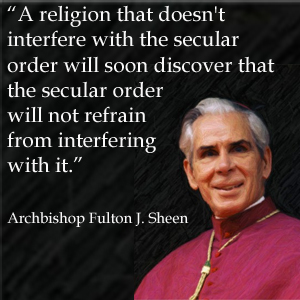
TUESDAY QUOTE OF THE WEEK CCLXX

FINDING TRUTH WHEREVER IT MAY BE FOUND:

IN OTHER NEWS:


Russ sent this great picture in:

From the Diocese of Cleveland Enewsletter:  Bishop Lennon calls Catholics to protect the relgious liberty of all.  Read more here.
 
From the same source:  There has been a change in time for the televised Mass in Cleveland.  Read more here.
 
From the same source:  "Did you know, St. Peter Parish located at E. 17th Street and Superior Avenue in downtown Cleveland has scheduled a date for its opening Mass? Fr. Robert Kropac is the St. Peter Parish pastor."  If you are unfamiliar, this is the parish that, upon learning they were to close, rented a building and began having thier own Masses.  Read more here.
 
Fr. K from New York sent in yet one more flash mob - this one IN POLAND and IN POLISH but it is probably one of my favorites.  Most seem to happen despite the crowd around them.  These guys at least TRIED to include everyone.


HAPPY LABOR DAY!

This must be one of the most unique holidays in all of the catalogue of holidays.  What other holiday do we celebrate NOT doing what the holiday celebrates?  On Independence day do we celebrate by taking a day off from freedom?  On St. Patty's Day do we celebrate one day on which we need not be Irish?  On St. Valentine's Day do we take a day off from the chaste love of a mate?  No!  In fact we indulge more deeply into these things!  Perhaps today would be better entitled, "Rest from Labor Day" (Save for those of you who are working.)
 
 
For those of you at work lucky enough to be able to celebrate what this day is all about, here is a game to play on your break.  WARNING:  Addiction level MEDIUM
 
HAPPY LABOR DAY!

Friday, August 31, 2012

FRIDAY POTPOURRI: FIRST THINGS AT FIRST COMMUNION


At baptism I tell parents that this is only the first day of their child’s baptism.  It is the beginning of a relationship and a process and that they have only begun the journey.  One of the milestones on the journey is the child’s First Eucharist.  How a child reacts to the Blessed Sacrament is highly dependent upon the parents.  Faith is not handed down in Church, CCD or PSR, in the day school or what have you.  It happens in the domestic Church – in the home – one generation handing on the faith to the next.  This translate to the reception of the sacraments.  How seriously will the child take Jesus in His Eucharistic presence?  How do his parents behave around the Blessed Sacrament?  How seriously do they take receiving Communion?  How well do they take what they do in Church home?  How do they speak of it?
 

Quite typically there will be a social response to receiving First Communion.  As Mrs. Fenner takes pains to express, “it is your opinions and your reactions that they value and imitate.  It is you therefore that can bring home the wonder and joy of the great sacramental occasion.  Do everything in your power to make the day of First Holy Communion meaningful.  You do this by putting emphasis on the reception of the sacrament and its significance.”
 
As C. S. Lewis said, “When first things are put first, second things are not suppressed but increased.”  So when First Communion becomes about a party at which First Communion happens to be a part, the whole event suffers.  The significance of the Blessed Sacrament is lost and so the reason for celebration is lessened.  It becomes not much more than a fancy dress occasion and not a very exciting one at that.  But, when First Communion is emphasized, not only is due reverence made to Christ and the child’s excitement increased, the festivities that accompany it are also raised up in significance. 

Thursday, August 30, 2012

DANCE STEP


“The Church is out of step with modern society.”  Can anyone deny this?  How many times might this have been said since the day after the Resurrection?  It is said like a reprimand.  “If you want the Church to have any sway in modern culture, it has to become more like modern culture.”  Which, when you think about it, is a little like saying that the only way Church can speak to moderns is to have nothing new or interesting to say to it.  It would be just another “Aye” to whatever is going on even if what is going on is radically different in Maine than it is in California.
 
The problem really is that modern culture is out of step with the Church.  There has been any number of modern cultures these past two thousand years and there are any number of modern cultures alive today.  Modern culture in Japan is different than modern culture in Iraq or any other two countries or parts of two countries that you might want to pair together.  The one common thread is the Church.  It remains constant for 2,000 years and across borders.  It would be less of a logical thing to make Church psychotically run around approving of every apparition of “modern culture” that may exist on any particular square mile of civilization than to unite all of humanity under one banner of Christianity that can speak to them all.
 
That the Church is out of step is no wonder.  It never changes it step.  It is hard to keep in step with someone who keeps changing the dance without notice and fumes because not everybody is falling into step.

Wednesday, August 29, 2012

GUEST BLOGGER: POVERTY OF FRIENDSHIP

Greetings friends,


Today we have a guest blogger (saving me from a tight schedule today.)  Mr. Ryan Mann is a seminarian for the Diocese of Cleveland.  I hope you enjoy his thoughts and that it spurs some thinking in your part of the cyberworld.


Last fall, while interning with the Archdiocese for the Military Services, USA in Washington D.C. a priest friend came to visit. One night, on our way to dinner, we were stuck in traffic - not surprising for the District. As I looked out my car window I saw a homeless man nestled into an abandoned store’s stoop. I turned to my friend and asked, “Do you think you could ever end up homeless?” With almost no hesitation he quipped, “No, I have friends.” I was silent with awe.
Over the next few weeks I shared this story with other friends in the area. Each one responded with a similar awe.  This priest’s response was so obvious and simple, and yet not one of us ever thought of it that way. After sitting with this for a while, I came to realize that my priest friend’s response was the right response (the point I am making here is not the cause of homelessness, but the nature of friendship revealed in my friend's comment).

Friendship isn’t simply a nice thing to have. Aristotle, for example, taught that friendship is necessary to become fully human. Without friendship virtue would be beyond our reach and life itself would be lonely and dull. And yet, as good Americans, my friends and I felt a very different ethos animating our bones and tainting our minds. This was the modern mind that sees an individual at the basis of all society, and tells us to depend on will power, ingenuity, and hard work to avoid situations like the homeless man. This worldview was at odds with the simple and enlightening answer of my friend, and I'm sure that is why it shook me up so much. He spoke from some other world, from some other place, and it was simple, profound and transforming.
This “other world” is none other than the Kingdom of God. This priest’s radical vision was Jesus’ vision. Throughout the Gospels, Jesus like Aristotle never does anything on his own. He is constantly referring to the most basic element of His existence, his relationship with the Father. Jesus says things like: “…the Son can do nothing of his own accord, but only what he sees the Father doing.” (Jn 5:19). On the Cross - a situation much worse than being homeless - Jesus sighed, “Father into your hands I commend my spirit” (Lk 23:46). He was not even going to die of his own accord. These pronouncements disclose that Jesus was not a modern American whose trust resides in himself. Jesus’ trust was in his Father and it was this relationship that made him so radical 2,000 years ago and continues to make him radical today.
The problem for most of us is that we have accepted a dangerously modern approach to life. Aristotle’s insights have been dismissed as antiquated and Jesus’ revelation is seen as weak and idealistic.  We are told to trust nothing other than our own ego and “when the going gets tough, the tough get going.” I assume this means that real men and women buckle down and think more, work harder and adapt. While hard work is not to be avoided and ingenuity is praiseworthy and good, we are not saved by our efforts but by grace, by the community where Christ lives, the Church. This way of being in the world is mysterious and strange, but mystery and strangeness is the nature of Christian living.
It’s something of this mysterious way of being in the world that my priest friend knew and revealed to me.  He knew friends are there to laugh with and challenge you to grow, but in a revolutionary way he also knew that in those painful and tough times friends are there to help you. When we are most vulnerable and in need of help we don’t need to do it alone. I never thought I’d be homeless, but now, because of a friend, I know why.

Tuesday, August 28, 2012

TUESDAY QUOTE OF THE WEEK CCLXIX

FINDING TRUTH WHEREVER IT MAY BE FOUND:  "If you want things to prosper you have to use them in accordance with their nature." ?
 
QUOTE II:  "If excellence is to be expected . . . you can't ask the wrestlers to throw the javelins." from Amor Towlese's "Rules of Civility"
 
IN OTHER NEWS:
 
This was sent in, "Please visit the website, pillarsofcatholicism.com to register for the course "Pillars of Catholicism." Simply click on the 'Go to Course' button on the bottom of the page and a registration form will appear."
 
My sister took this picture of Sebastian on our trip back from New York.  He is looking out the window of the car and the picture is taken into the side mirror.  Too bad I don't keep my mirror cleaner.
 
Frank sent this video in.  Will you ever believe your eyes again?
 
Here is another video sent in from Brian M.  It is the first two presentations at Forest Lodge staring ME!  Faith Lodge is a coffee house at St. Sebastian every Thursday night at which there will some sort of Catholic presentation.  This series is the first two of three part series on Saints, Signs, and Symbolism.
 
The Diocese of Cleveland Enewsletter sends in this FYI: "The Department of Communications has been notified by the management of Cleveland television station FOX8, that the weekly Sunday morning broadcast of the "TV Mass" is being moved from 6:30 a.m. to its new time of 6:00 a.m. effective Sunday, September 2, 2012."  Read more here.

Monday, August 27, 2012

MONDAY DIARY: A PEEK IN ANOTHER PRIEST'S DIARY

There was a nice gathering at the St. Sebastian rectory a couple of Fridays ago.  My classmate is the pastor one parish away.  Fr. Pf, our parochial vicar, has a classmate that is my classmate’s parochial vicar.  We had a seminarian staying with us for a two week “rectory experience.”  His classmate was at my classmate’s parish too.  So they all came to St. Sebastian for dinner, along with one of their home grown seminarians, our two seminarians, and Fr. Swirski who is in residence at St. Sebastian (and of course, Sebastian.  If the rectory had blown up it would have been a serious blow to the percentage of clergy in Summit County.


After dinner, those who were brave enough climbed the bell tower.


Back to Fr. Swirski who helped round out the generations of those gathered.  He will not be in residence at St. Sebastian much longer though hopefully he will still be doing some of his ministry here.  It has been fascinating hearing his life story starting as an orphan in Poland, fighting in World War II, and befriending a young priest by the name of Karol Wojtyla who would later become Blessed John Paul II.  Unfortunately Fr. “Ted” is rarely any longer able to dredge up stories of his early years at will.  They can still come up naturally but often not when called upon.  Soon his stories may disappear.
 
If I piece together his narratives correctly, he first met the young Fr. Wojtyla as a new priest.  Fr. Ted was traveling (in Poland) and needed a place to stay for the night.  Someone directed him to a nearby rectory.  It was late and the lights were dimmed.  He went to the back and knocked at the back door.  There he waited.  The door swung open and Fr. was greeted with pan full of water and suds being thrown on him.  The housekeeper had not heard his knocking, had been giving the pastor a shave, and had opened the door to throw the shaving water out into the dark!  Fr. Ted was drenched.  The pastor came out to see what all the brouhaha was about and the housekeeper said, “I just through water on this seminarian in the dark!”
 
“Not seminarian,” said Fr. Ted, “Already priest!”
 
At that he was invited in and introduced to a priest who would become the future pope who was the assistant there at the time.  “He was so kind with me as a new priest,” reports Father, “and he stayed up late talking to me and giving me encouragement.”


That was not the last Father would come across Fr. Wojtyla.  Fr. Ted, at a very young age, (the Church in Poland was trying to rebuild itself after the war) became pastor of a parish near a lake.  Apparently his fellow priests would come out to the lake to enjoy a couple of days of retreat from time to time.  Fr. Wojtiya being among them was apparently an expert swimmer and enjoyed many hours in that lake.  Fr. Ted often used sound effects to tell stories and would say, “He would dive in the water and go woo, woo, woo,” indicating, I think, that he swam like a fish, “and so we called him ADMIRAL!”
 
The rectory was small and they had to set up temporary beds.  Apparently the future John Paul was offered one of the remaining beds.  He, however, turned and asked, “Who is the oldest?”  When the oldest priest was presented JP said, “He shall have the bed!  I shall sleep on the floor!”
 
I guess they also used to call him Lolek, something well known, but according to Fr. Ted they also called him Stash for some reason I cannot seem divine from Father’s stories.  (Maybe someone can clarify.)  A new story came up this past week that we had not heard before.  “Stash” came to the United States for a visit (before he became pope) and visited Fr. Ted in Akron.  They went to our Cathedral church and Fr. Ted said, “See how many people go to Communion!”  And the future pope had a look of concern and said, “I hope that they are all prepared to go and make use of the sacrament of confession.”
 
It has been very interesting living with Fr. Ted these past three years.  Maybe this will help his stories live on a little longer.

Friday, August 24, 2012

FRIDAY POTPOURRI: HOW TO DIE


Part of the problem of telling people how to die is that they don’t want to talk about it until it is painfully obvious that they or someone with whom they are close are about to.  But it is handy information to have in your hip pocket.  Nobody likes to take up research on the topic when death is a few heart beats away. 
 
Here is one of the most important things you should know:
Imminent death is not a prerequisite for the sacrament of anointing of the sick.
 
(I heard on the radio yesterday that if you say something three times people are more likely to hear and remember it.)
 
I have this image in my head of certain personages, otherwise holy, intelligent, good people standing next to a hospital bed with a stop watch and counting down the seconds.  “…three, …two…ONE!  We are down to two hours of life for Aunt Maybell!  Call the priest!  Call the priest!  Tell him to get out here NOW!”


At least that is the way it appears from this end of the telephone lines.  Save for cases of emergency such as getting hit by a truck, one should not wait until the last seconds to be anointed.  According to the Catechism of the Catholic Church, anointing is to take place at the onset of the malady.  (This has been true since Trent though perhaps not in practice.)  It may be repeated if the persons becomes well and then falls into sickness again, if the condition worsens, or if a long period of times has passed.  The condition must be serious however, though not fatal.
 
Why this information on a post about manners?  Because manners means making things run as smoothly as possible for everyone involved.  In this age of less priests and more duties for them to do, it is not in keeping with the best possible manners to unnecessarily cause an emergency.  Further, there is a risk of the person being denied the sacrament because of the lack of priests and the small window of time available that may be avilable.  Perhaps he is at a diocesan meeting two hours away and calls are being forwarded to another parish where the priest is already on another call and won’t be back for a couple of hours.  Knowing your sacraments and taking advantage of them when they are intended as possible is just plain good manners.  And of course there are always true emergencies, we just need not create artificial ones.
 
Times have changed since Mrs. Lenner wrote her book.  In describing how one should be prepared for an anointing she writes, “the room should be in perfect order, the patient should be bathed and wearing fresh night clothing.  A woman patient’s costume should always be modest.  Near the sickbed there should be a table covered with a white cloth and holding a crucifix, two lighted blessed candles, a vessel of holy water, a spoon, a dish with five or more bits of cotton, and a damask napkin.  If the priest comes bearing the Blessed Sacrament, as he will of the patient is conscious, he should be met at the door by a person bearing a lighted, blessed candle and be conducted to the sickroom.”
 
Though nice, in reality, none of this done today.  Here are my recommendations for a modern day anointing.  After determining that a anointing should take place, if the person is mobile it may done in the church by setting up an appointment with the priest.  If the person is not mobile, the priest should be called at the earliest convenience and a mutually agreeable date and time set.  I highly recommend NEVER being absent from your home for such an appointment because you had a beauty parlour appointment or a bowling banquet.  (Yes, this does happen!)  That makes priests, justifiably or not, very grumpy.


It would be nice, if possible, to have the room and person as presentable as possible.  This is for the comfort of the patient who is incapable of making their place presentable to visitors.  All of the accoutrements about which Mrs. Fenner spoke are no longer necessary.  I do recommend a crucifix being present in the room in general however since the Church grants an indulgence.  #28 from the book of indulgences states that “if the priest cannot be present, holy mother Church lovingly grants such persons who are rightly disposed, a plenary indulgence to be obtained in articulo mortis (at the approach of death) provided they regularly prayed in some way during their lifetime.  The use of a crucifix or a cross is recommended in obtaining this plenary indulgence.”
 
The priest should be told of the condition of the person especially if death is not that far away.  There is an apostolic blessing that the priest will give if the situation is dire.  It is desirable that family, friends, and loved ones, (and as it turns out, often the health care professionals) be present and pray.  Sacraments are by their nature public prayers.  Except for confession and counseling it is absolutely wrong to excuse yourself for the anointing so that there might be privacy.
 
AND FOR THE LOVE OF PETE – TURN OFF THE TELEVISION.  It is often the case that the television has just become background noise for all the people in the house, but it can be very annoying and, worse yet, distracting during the celebration of the sacrament since today Buffy and Kent are actually to be reunited after being divorced three times because Buffy just found out that she is pregnant by the recently deceased brother of Kent and is tricking him into thinking it is his child which he has always wanted.
 
Because of the laws of the United States, it is extremely important to tell the admissions office of your institution that you are Catholic.  Notification is no longer made to you parish and no inquiry will be made.  You must declare your religious preferences for the Church to know that you are in the institution and are desiring of sacraments.  The information fairly will no longer magically notify your parish.

Thursday, August 23, 2012

WHO WILL SAVE ART?


Once, during my idealistic years as a seminarian, I debated the role of artists in the Church with one of my professors.  I took the high road complaining that the Church, as patroness of the arts was betraying her role by ordering all of her art out of catalogues from where “art” (and dubious art at that) was stamped out, spray painted, and shipped out to thousands of churches throughout the world so that devotion to Mary could be like going to McDonalds in foreign cities; one need never fear being introduced to something spectacular or different.
 
He countered that catalogue art made it possible for those who can’t afford to commission an artist to produce something new to have something.  Besides, commissioning art can be dangerous.  Both of these points are well taken.  At the time I said, “If they can’t raise the funds, they don’t really want it.”  I might be less inclined to apply that standard across the board today.
 
Still, if we can do it, we ought.  It is a process that is both expensive and, in some cases, dangerous.  So here are two counter arguments for the problem of commissioning art being dangerous and the accusation that it is too expensive.
 
First, I do agree it can be a dangerous endeavor but by no means un-exciting.  By dangerous I mean this:  At a former parish a statue of Mary was commissioned.  When she was unveiled there was a collective gasp from those who were present.  The gasp was not in awe of the beauty of the statue but of mild revolt or at least disappointment.  There was nothing that symbolically told you that this was Mary in the least and her proportions were such that she gained the moniker “Stay Puffed Marshmallow Mary.” 
 
But what if we stop taking chances?  What if we no longer engage artists to create new and good religious art?  Artists will always seek out those who will commission them so that they may put food on the table.  If only the secular world will secure their services, then the only art in the world will be secular art.  If we want Catholic artist of any type, we need to support, encourage, and offer them our resources.  If not, the alternative is that we will have plastic art and the non-Catholic world will cultivate artists and the art world.


One of the many arguments against spending money on artists and their art is that the “money could be used to feed the poor.”  Yes it could.  This is an accusation often lobbed at the Vatican.  It is said that the vast storehouses of art and history should be sold to the highest bidder and the resources gained should house, clothe, and feed the poor.  That sounds in keeping with our Christian mandate. 
 
But then what?  The next day you will still have the poor and there will be no art for them.  It is not adequate to survive on cheese, a stark room, and some covering for your body.  The poor also need beauty.  That is why public art is so important.  It is why religious art is even more important.  How many places can you go to enjoy art?  Most museums have admission fees.  Our beautiful government  buildings discourage “loitering.”  Most other truly artistic buildings are either private or will cost the person entering it (clubs, restaurants, schools, etc.)  The possible exception might be the library.  But even so, how many of these places have art that point directly to the Creator?  To saintly living?  That tell the stories of salvation history?  That lead man beyond himself to something greater?
 
Then there is your parish church.  Nobody must pay for the holy water or the Body and Blood of their God.  Here prince and pauper alike hear some of the oldest literature on earth and are (hopefully) surrounded by good art and can listen to important music.  Where else does this exist?  And should all of this be sold and Catholics meet in a barn so that for a year someone was able to eat a cheese sandwich?  No, not food alone!  That in itself is a deprivation and a denial of all that it is to be truly human.  We are more than animal.
 
There are four things that will bring about our salvation: The One, the True, the Good, and the Beautiful.  And I believe that ultimately it will be the beautiful that will save us.  It is our duty not only to feed nutritious food to the poor, it is also sinful not to offer them (and ourselves!) the best, most nutritious food for the soul; art that we can reasonably supply.
 
This is not an exhaustive arguement - but the beginning of the conversation.

Wednesday, August 22, 2012

WILL THE REAL MARY PLEASE STAND UP

Happy Feast of the Queenship of Mary!  It struck me the other day how many depictions of Mary that we have in the rectory and in the church.
 
I did not dare go into the school or this presentation would have doubled with all of the classroom statues and what not.  The one above is a plaster statue that sits outside of the chapel in the rectory.  It doesn't actually belong to us.  We are "storing" it for another priest.  But why not have it out and appreciated.  The tapestry below is in the rectory chapel and is a souvenir of mine from our choir's concert tour in Italy.  I take it to the church on feast days.
I remember being somewhat young and going to a parish that had Mary depicted as an African woman.  My initial (private, thank goodness) reaction was, "That's not Mary."  Of course it was a ridiculous thought because we have not the slightest idea of what Mary looked like.  She was most certainly not the porcelain skinned woman we most often see her as. 

 
The object is not to get the picture factual, but to portray some truth.  That, in large part, is what icons are all about such as the one above.  Not much attention is even given to correct proportions of facial features but to suggest theological truths. 


What should our depictions of Mary lead us to?  Not to appreciate a particular face but to fall in love with who she was.  It does not really matter what she looked like.  What is important in liturgical art is that it leads us to what made her special and to what (and to Whom) she leads us.


For some reason there are about a half a dozen pictures that will not transfer to my blog.  Maybe it is for the best.  The above which hangs in the rectory is one of my favorites.  It is so simple.  It provides a moment of rest to a busy day whenever I pass it.  


The statue below has an exact replica in front of the rectory (one of the pictures that did not turn out.)  Legend has it that someone once stepped on the gas instead of the break and took Mary out.  She was repaired but the driver insisted on replacing her.  So below is the new statue and the old with some barely visible cracks through it now sits in front of the loggia of the rectory.


Things could not get more different than the statue above.  Mary is relative of Mr. Goldfinger. Ra ra ra ra ra.  It is a nice enough statue and goes well with the church.  I do not find it particularly enticing as a focal point for devotion.  Perhaps that is why Mary is so widely depicted.  She is the universal saint, a saint for everybody.  Could one depiction really capture her uniqueness and universality?  Perhaps there is a Mary depiction out there for everybody.


And above is Our Lady of Guadalupe.  Certainly here is a different depiction of our great saint.  But the Church universal has come to love her in this depiction yet Mary certainly was not an Indian looking woman.  But I wouldn't disguared this depiction of her for anything because it does tell us something about her and more importantly about God.
The finaL picture below is of the Cosmic Madonna, a signed print by Salvadore Dali that hangs in the rectory.  The strange cross between Mary and a what appears to be church architecture and perhaps some elements of the cosmos is not a warm fuzzy.  This is not a Mary to be crowned or have flowers set in front of.  Yet it tells us of some aspects of Our Lady that are none-the-less compelling.
 
May Mary, our Queen and Our Mother bless your day and her depictions bring you peace, joy, and insight into God, her, and you.


Tuesday, August 21, 2012

TUESDAY QUOTE OF THE WEEK CCLXVIII

FINDING TRUTH WHEREVER IT MAY BE FOUND:  "They say the reason women are willing to give birth again is because they forget, but it's not.  Even though you remember the agony and the blood, you also remember that, where in one instant your arms were empty, in the next there was life - the newest, purest form of life.  And it came from you.  Eyes that are thirty seconds old can pierce through every awful memory.  At that moment you don't need to forget.  You would do it all again."  Toni Ouradnik in Sun Magazine


QUOTE II:  "The essence of chastity consists in quickness to affirm the value of the person in every situation,"  Karol Wojtila (John Paul II)

IN OTHER NEWS:

Ellen sent this link to observations from the last Chesterton Conference (which is always too far away!) 

One of my favorite writers/preachers in the diocese has put out a new article.  You may read Fr. D's article on smoking here.  Only if you liked it you might enjoy this article on smoking.

Here's a picture from the Jazz festival.  No, we were not dancing.  We were trying to read the winning tricket and I was leaning over to the microphone. 

K sent this in:  Oberlin Art Exhibit: "This exhibition includes over 30 works—sacred and secular, from both Northern and Southern Europe, and dating from the late 13th–early 17th centuries—on loan from the Yale University Art Gallery. These works will be hung alongside stellar examples of Renaissance art from the AMAM permanent collection."  See more here.  Thanks!

Here is the listing for the upcoming year of the First Friday Club of Greater Akron.  Other Diocese of Cleveland First Friday Clubs may be found here.

Stummbled across this.  Awesome!
Things have been so crazy around here I cannot remember if I have shared this with you or not.  Amanda sent this in about Imagine Sisters: "Imagine Sisters is a web and campus-based movement that aims to inspire the imaginations of young women to consider the beautiful call to consecrated life as a sister."  Read more about it here.  She adds, "Please spread the word about the movement in general... And if you know any priests or religious that would want to get involved or contribute please inform them about the movement and the contribution form!"