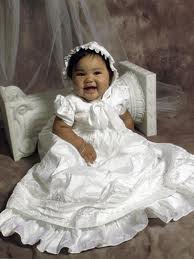
 It is actually part of the baptismal rite that the newly
baptized be clothed in white garments.
The prayer after the baptism reads, “See in this white garment the
outward sign of your Christian dignity. . .”
Often parishes have some sort of garment, often a bib or scapular type
contraption (just in case the baby is going out to eat lobster after) that
suffices for ceremony’s sake. It is not
strictly necessary if the baby is already properly attired.
It is actually part of the baptismal rite that the newly
baptized be clothed in white garments.
The prayer after the baptism reads, “See in this white garment the
outward sign of your Christian dignity. . .”
Often parishes have some sort of garment, often a bib or scapular type
contraption (just in case the baby is going out to eat lobster after) that
suffices for ceremony’s sake. It is not
strictly necessary if the baby is already properly attired.
The most common/traditional type of garment as Mrs. Fenner
reminds us is a long white robe usually lavishly (though, again, not necessarily)
trimmed with embroidery or lace. “This
is the one time when a baby may be so dressed without violating the canons of
good taste,” she reports. For some
reason that is lost on Monsignor Manners, she also stresses that, “Fine white
silk, unstarched organdy, fine lawn, nainsook, and handkerchief linen are
suitable materials. Chiffon, satin, and
taffeta are not.” Perhaps someone out
there in Catholic land can enlighten me as to why this might be the case.
 Mrs. Fenner also stresses that the entire garment should be
handmade including the lace and/or trim.
Monsignor is not so fussy. (Do
you know anyone who makes lace by hand anymore?) She also finds droll the all white
suit and manly caps for boys hoping that, “it may be a fashion that will pass.” It certainly is not in keeping with tradition
at any rate although all the ceremony calls for is a “white garment.” It certainly would be better than a lobster
bib.
Mrs. Fenner also stresses that the entire garment should be
handmade including the lace and/or trim.
Monsignor is not so fussy. (Do
you know anyone who makes lace by hand anymore?) She also finds droll the all white
suit and manly caps for boys hoping that, “it may be a fashion that will pass.” It certainly is not in keeping with tradition
at any rate although all the ceremony calls for is a “white garment.” It certainly would be better than a lobster
bib.
Monsignor Manners found his baptismal garment when closing
down the family house. It was a rather
fluffy affair more suitable for an American Girl Doll than a baby boy and the
evidence has since been disposed of.
 In any event, at the baptism head gear of all sorts should
be removed. The child will have water
poured over his head and need to be anointed with Chrism. Also, the neck of the garment should be
loosened so that the priest may anoint the child on the breast with holy oil
(another difficulty with bow ties!).
In any event, at the baptism head gear of all sorts should
be removed. The child will have water
poured over his head and need to be anointed with Chrism. Also, the neck of the garment should be
loosened so that the priest may anoint the child on the breast with holy oil
(another difficulty with bow ties!).
The above is most usual.
But there are other practices at your parish for which you may need to
be prepared. For example you may have a
dunking booth for a baptismal fount.
This requires a whole different set of rules. If the baby is going to be submerged in the
same clothing with which he came from the womb, you should bring a robe (white
and easily administered) to be clothed in immediately following the
baptism. In this case, the little man
suite would definitely be a problem and a time consumer. If you are hooked on the suit, save it for
the party.

If the child is to be baptized in the extraordinary form,
access to his back for anointing must also be taken into account.
What should guests wear?
Mrs. Fenner suggests, “the same kind of clothes what they would wear to
. . . Mass.” Monsignor suggests that one
finds out what a guest wears to Mass before issuing this advice to one who
asks. Suits and dresses carry the
day. Hard to go wrong with that
especially for the parents and godparents.
I also suggest that if your guests (or your spouse) who normally comes
to Mass in a T-shirt and cut offs actually appears at your family’s baptism
like this you might encourage them by saying, “Wow, you look really, really
great! I think you should dress like
that every Sunday! You’ve been turning
heads all day!”
Nothing like a bit of vanity to get people to do the right
thing.