Sunday, March 12, 2017

MONDAY DIARY: ALMOST EXCRUCIATINGLY TRUE STORIES: IT WASN'T ME. IT WAS MY DOG

So as you know I have a dog named Sebastian.  I've written a lot about how much ministry he does around here.  There have been meetings where people have said, "Father I was so nervous coming in to speak with you, but your dog came and sat by me and I knew everything would be Okay."  

Mostly those stories are still true.  But things have changed.  For example, when I have a couple in for marriage prep and we sit at my desk, it used to be that Sebastian would sit quietly at my feet on my side of the desk.  This is not longer the case.
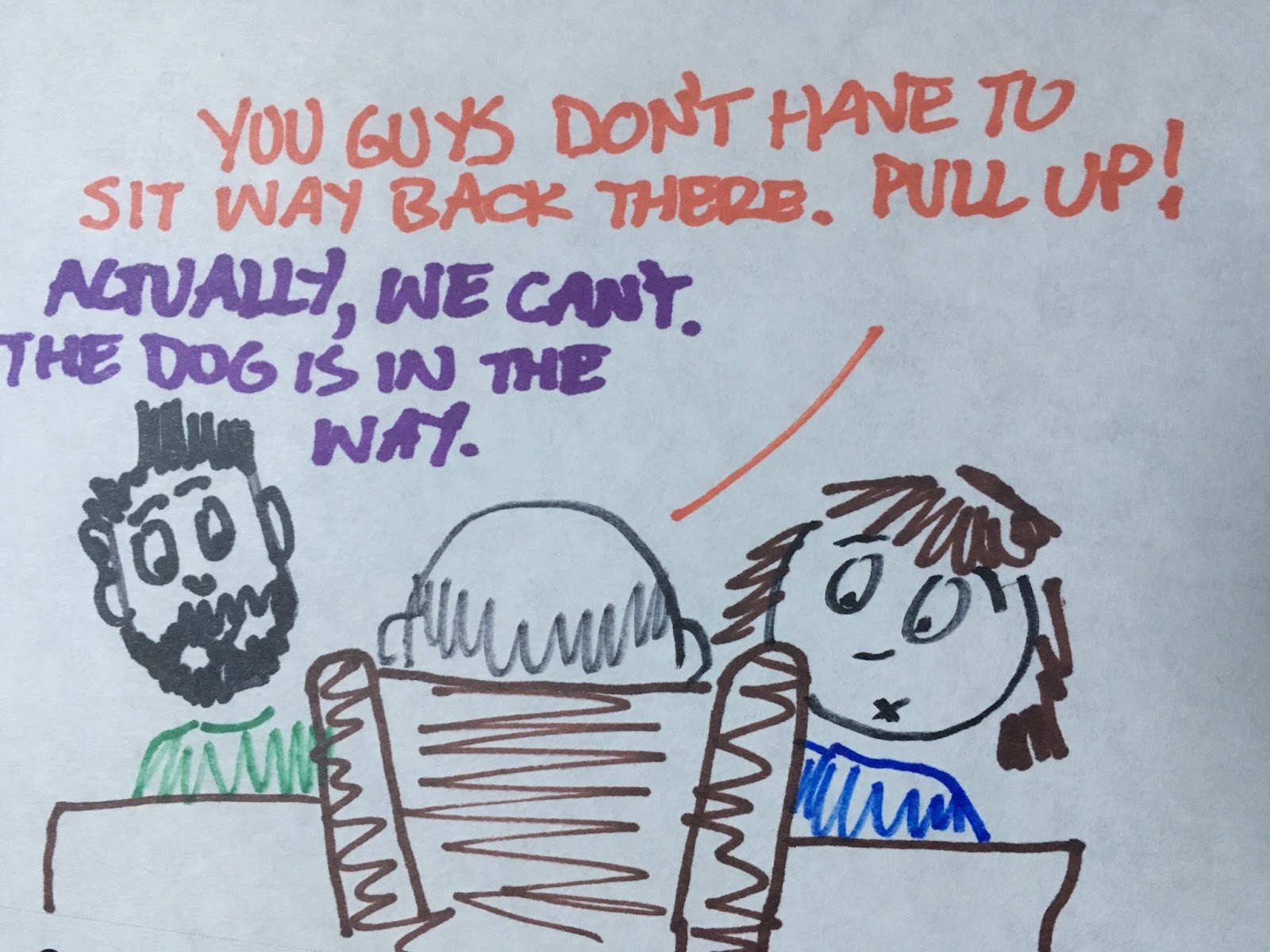
And as Sebastian gets older, he's starting to make noises like an old Norwegian farmer bachelor who never had anyone living with him to tell him that he was starting to make strange noises that, in his youth, he was savvy enough to keep to himself or at least for when he was alone.
He has taken to making these moaning noises.  Think of a five-year-old who is board out of his skull and has just sat down on the living room couch and as soon as backside hits the cushion you say, "Help be bring in the groceries."  Mooooooooooooooan!

If Sebastian is inconvenienced in anyway, he does not politely move out of the way, he moans as if the world is so self centered and impolite as to not let him sit in the most inconvenient spot possible.

Then as we move along, he will fold himself into what looks like a black meatloaf with some  random appendages sticking out and start slurping at himself.  Not a nice polite kitten-like cleaning of cute little paws but more like a pig at a slop fest.
That's when you KNOW he is a lot smarter than he lets on.  THIS is why he now sits on the other side of the desk now.  Before I could lean down, stroke his head and quietly say, "Sebastian, stop it," and he would.  But being on the other side of the desk, I am completely helpless.
But inevitably the couple will politely say, "Oh that's Okay.  He's just fine and so are we."  I know - I KNOW - I KNOW I should escort him out of the office but if I stand up to do so, one or the other will say, "Hey Father, I grew up with dogs.  It's Okay.  Leave him where he is."

BUT


Then we will get to the most sensitive part of the night's discussion.  Things very intimate and serious.  And just as I get to the most touching, beautiful, holy part there is new noise.  It's hard to describe.  It started a year ago.  It is difficult to describe accurately save to say it is very, very loud.  I am not quite clear how it is accomplished.  I know it demands a tighter meatloaf-like position and involves a moan to get there.  He kind of vibrates when he makes it.  And the sound . . . there is definitely some element of slurping, something that sounds like someone giving you the raspberry, a bit of snorting, and dash of honking noises.
Of course, that is when I lose it.
But couples who are getting married are crazy happy and unperturbededly polite and pretend that nothing is going on.  And I feel poorly.  It's my bad.  I should know better.  But I appreciate their understanding. 

Friday, March 10, 2017

FRIDAY POTPOURRI: RIGHTS

Enough with all of the preparations, clarifying of conditions and examination of intentions.  Let’s get on with the actual wedding already.

The priest says, “Since it is your intention to enter the covenant of Holy Matrimony (almost asking the question one more time this is your intention isn’t it?) join your right hands and declare your consent before God and His Church.”

Did you ever ask yourself, “Self, what’s up with the joining of right hands?”  Well I have.  Why not join both hands?  Why not left in right as they stand next to each other?  Why not join left hands since that is the hand on which you will wear your wedding ring?  (More on that later.)  Why join hands at all?  Why not just stare at each other?  

So I tried to do a little research for you.  (This first part is my opinion - nothing that I discovered about Catholic symbolism.)  I suppose some of it is that it is further and intense clarification.  It seems more than with any other sacrament, we have a desire to be extremely precise with matrimony.  “Who is this person going to marry?  Why the one whose right hand is held.  Can’t mistake that one.  That guy is definitely not accidentally getting married to the lady in the front row.”

There is a lawyer in the parish who joshes me about being so precise about things.  Even with the Eucharistic Prayer, I am very conscious about making eye contact with the species that is about to be consecrated.  (This is not in the rubrics.)  So when consecrating the wine, at some point I will glance at all of the chalices on the alter.  I just find this mindful.  I am not intending to consecrate the loaf bread you happened to bring in on your stop at Acme No. 1 before coming to Mass.  So could this holding of right hands have this precision in mind?  Everything the Church does seems to always clarify something that someone in the past has misunderstood.

The little bit that I could find is that it could possibly have pagan origins.  This will send some people over the edge.  “See that?!?!  The Catholics are doing something that pagans used to do!  That proves they are following Satan!”  As if a pagan cannot be baptized for the glory of God.  Not everything pagan was evil or bad.  They had some awesome ideas.  I mean, ancient paganism (not the knock off excuse for paganism modern forms are) gave way to Christianity.  These guys were not completely off track.  

But I digress.


It was part of more ancient ceremonies that hands were bound.  The hand clasp is an ancient sign that an oath is being engaged between two parties - marriage being one of them.  This is the serious moment.  We are done talking and negotiating.  It is obvious that the couple is aware of what is about to take place with this formal gesture in front of these witnesses.  Even if you cannot hear it, you know that this is the moment of truth.  It is the right hand that grasps the hand of the other, not a weapon or any other such thing.  You are the one to whom I am about to give myself - in a way that has been done since even before Christianity though now the gesture is baptized for us.  This seemingly inconsequential action is so ancient, so recognizable, so ingrained into our culture and humanity, is so heavy with tradition, that it is even announced, “Join your right hands and declare your consent before God and His Church.”  

Wednesday, March 8, 2017

HEADS UP FOR ToT AKRON TONIGHT!!!

CANCELLED EVENT:  The Winking Lizard had to close its kitchen and has no water and so is unable to host Theology on Tap Akron tonight!  Please let you friends know!  Keep an eye out for future events!  Sorry for the inconvenience!

GUEST BLOGGER: CAPITOL ERRER

  1. Guest blogger:  Bernard A. Smith, of St. Sebastian Parish, Akron, recently retired after serving over  three decades as a federal prosecutor handling organized crime, public corruption, labor racketeering and appellate cases. He obtained a bachelor’s degree from the University of Dayton in 1979 and a law degree from the University of Michigan in 1982.   
When Pope Francis spoke before a joint session of Congress in September 2015, he urged that the death penalty be abolished throughout America, a request with which one might presume a career prosecutor would disagree. Such an assumption would be incorrect, however, for Pope Francis’ request of Congress did not merely express a personal policy preference but was firmly grounded in Church teaching. As the State of Ohio contemplates executing condemned criminals for the first time since 2014, understanding why capital punishment cannot be morally justified is of paramount importance. Indeed, rather than tolerating executions, the citizens of the State of Ohio should demand that the death penalty be abolished. 
American criminal law traditionally has recognized a necessity exception to the prohibition against intentionally killing another person, taking several forms: (1) self-defense when faced with imminent threat of deadly force, (2) defense of a third person faced with a similar threat, and (3) soldiers in combat facing an armed enemy. To this list during the colonial period of our nation’s history might be added capital punishment, because secure prison systems had not yet been invented.2 As secure facilities to imprison the most dangerous offenders did not exist, public executions were thought necessary both to incapacitate dangerous criminals and to deter others.
Today, any issue concerning lack of adequate prisons has disappeared, as both federal and State prison systems contain maximum security facilities to incapacitate murderers and other violent offenders. This fact makes a definitive moral difference, as articulated by Pope St. John Paul II in his encyclical letter Evangelium Vitae, which defended the inviolability of human life. Discussing capital punishment, Pope John Paul stated:  “It is clear that…the nature and extent of the punishment must be carefully evaluated and decided upon, and ought not go to the extreme of executing the offender except in cases of absolute necessity:  in other words, when it would not be possible otherwise to defend society. Today, however, as a result of steady improvements in the organization of the penal system, such cases are very rare, if not practically non-existent” (emphasis supplied).4 The Pope then declared that “if bloodless means are sufficient to defend human lives against an aggressor and to protect public order and the safety of persons, public authority must limit itself to such means….” (emphasis supplied).5 The mandatory character of the latter statement is unmistakable. 
In short, according to Pope St. John Paul II, the moral test of strict necessity governs when even a murderer may be executed and, because of security enhancements in modern prison systems, the set of offenders who must be executed in order to protect society is functionally a null set. Under modern conditions, therefore, capital punishment cannot morally be justified under the strict necessity test, a standard which helps to protect the bedrock principle that a person’s right to life is inviolable.
After the publication of Evangelium Vitae, the discussion of capital punishment in the Catechism of the Catholic Church was revised. Now, paragraph 2267 of the Catechism says that the death penalty may be imposed, “if this is the only possible way of effectively defending human lives against the unjust aggressor.” It incorporates Pope St. John Paul II’s teaching that if “non-lethal means” suffice to protect society, then “authority will limit itself to such means” (emphasis supplied).7 Paragraph 2267 then concludes:  “…the cases in which the execution of the offender is absolutely necessary are very rare, if not practically non-existent” (emphasis supplied).8 In light of the Catechism’s teaching that, as a matter of practical reality,  circumstances in which capital punishment could be permissible do not exist, imposing the death penalty cannot morally be justified. To the extent that our legal system permits capital punishment, it is morally flawed. 
Other considerations also undercut any moral basis for capital punishment. In the Supreme Court’s 1972 splintered decision in Furman v. Georgia,9 which temporarily invalidated the death penalty nationwide, the controlling three-Justice plurality variously found that capital punishment as then administered was being imposed in an arbitrary, capricious or discriminatory manner largely because a jury’s discretion to impose it was unfettered. The death penalty was revived, however, only four years later in Gregg v. Georgia,10 where the Court approved a capital sentencing scheme requiring a trial bifurcated between guilt and penalty phases, lesser included offense instructions where applicable, a jury’s finding of at least one aggravating factor beyond a reasonable doubt, the weighing of mitigating factors against any aggravating factor(s) and  appellate proportionality review in relation to similar cases. In sum, a jury’s discretion concerning the death penalty would be guided by legal standards. The implied premise underlying Gregg is that the courts are capable of ensuring that a capital sentencing system will function fairly.11 
Forty years later, however, the data demonstrates otherwise. A 2005 study conducted by the Associated Press found that, in Ohio, a defendant who kills a white person is twice as likely to receive the death penalty as a defendant who kills a black person.12 The organization known as Ohioans To Stop Executions has reached the same conclusion.13 Even more sobering, the final report of the 2014 Joint Task Force to Review the Administration of Ohio’s Death Penalty cited an ABA Ohio Assessment Team study indicating that offenders who killed white persons were 3.8 times more likely to be sentenced to death in Ohio than those who killed black persons.14 Racial disparity in capital sentencing based upon the race of the victim has been found in numerous studies conducted in other death penalty states as well.15 And, Ohioans to Stop Executions has found that “two-thirds of all Ohio murder victims are people of color, yet in 2013 three out of four new death sentences were for the murder of white people.”16
Imposing the ultimate penalty—death—based upon the race of the victim is inconsistent with the concept of equality before the law. Nor can this practice be squared with the basic principle that all human beings are of equal, infinite value before God. When the death penalty is imposed far more often against killers of white persons than against killers of minority persons, then our society has concluded that it values the lives of white persons more than the lives of minority persons because it systematically imposes a harsher penalty when the right to life of a white person is transgressed. The statistics show that murdering a white person effectively is regarded as a more serious offense than murdering a minority person because the consequences of killing one versus the other systematically differ. Such systemic racial discrimination inherent in the capital sentencing system must be condemned as morally bankrupt. 
Adding further moral weight against using capital punishment is the reality that the death penalty is sometimes imposed upon innocent persons. According to criteria established by the Death Penalty Information Center, since 1976 there have been nine exonerations of defendants who were sentenced to death in Ohio alone.17 “Exoneration” means that all charges against the defendant ultimately were dismissed, that the defendant was acquitted at a re-trial or that the defendant was pardoned based upon substantial evidence of innocence. No system of justice worthy of the name can tolerate not only the possibility that innocent persons might be sentenced to death, but also the established fact that innocent defendants have actually been sentenced to die, including in Ohio. 

In sum, the death penalty does not satisfy the moral test of strict necessity and is imposed in discriminatory fashion despite four decades of judicial effort to render the system fair. The citizens of the State of Ohio should conclude that capital punishment can no longer be tolerated because it is fundamentally indefensible and should demand its abolition. 

  1. added above
  2. Banner, The Death Penalty:  An American History, p. 23 (Harvard University Press, 2002). 
  3. Ibid., pp. 10-13.
  4. Evangelium Vitae, para. 56. 
  5. Ibid.
  6. Catechism of the Catholic Church, para. 2267.
  7. Ibid.
  8. Ibid.
  9. 408 U.S. 238 (1972).
  10. 428 U.S. 153 (1976).
  11. Lazarus, Closed Chambers:  The Rise, Fall, and Future of the Modern Supreme Court, p. 117 (Penquin Books, 1999).
  12. Akron Beacon Journal (May 7, 2005)(reporting the Associated Press study). 
  13. www.otse.org.
  14. Joint Task Force to Review the Administration of Ohio’s Death Penalty, Final Report and Recommendations, April 2014, Commentary to Recommendation 29.
  15. Lazarus, Closed Chambers, p. 168 (summarizing the results of the famous Baldus study in Georgia); see generally, Bedau, The Death Penalty in America:  Current Controversies, pp. 29, 271 (Oxford University Press, 1997).
  16. www.otse.org.
  17. Details about Ohio’s exonerations are reported at www.otse.org.

Tuesday, March 7, 2017

TUESDAY QUOTE OF THE WEEK CCCLXXXI

FINDNG TRUTH WHEREVER IT MAY BE FOUND:  "How humbling it is that the Father who made the trees and the animals, the world in all its wonders, the universe and all it grander, our galaxy in all of its majesty, and the cosmos in all of its beauty, thought that all that needed one of me."  This is not a direct quote - it was part of a talk by Chase Bills (St. Sebastian Parishioner) for the First Friday Club of Greater Akron.  Perhaps it would be more fair to say this is the way her comment stuck with me rather than a direct quote.

IN OTHER NEWS:

If you are interested in hearing more from the First Friday Club of Greater Akron, go HERE.

Sr. Maria Anna Melody wrote in to say, "I am writing you today to invite you to a superb grace available  through a series of radio shows available on this website through Radio Maria.  Mother Jacinta Miryam gave a 4 months weekly radio show about a small booklette written by Pope Leo XIII called Practice of Humility.    This booklette was given to Mother when she was a brand new Sister.  The Holy Spirit spoke to her very clearly about the meaning of humility at the beginning of her religious life."  Find out more HERE.

You can print the booklet for yourself HERE.

I was caught dancing with Fr. Pfeiffer's Mom at our last concert:

Concerning yesterday's post:  Kevin sent in this picture of a truly epic priestly beard from the days of yore.  AWESOME!

Christopher P. puts our homiletic podcast together.  Recently he sent in this information that I found interesting:

Here we go….
401 people have listened to the St. Sebastian podcast.

Top 10 Cities
1)      San Francisco, CA (?)
2)      Akron, OH (?)
3)      Chicago, IL
4)      Barberton, OH (this is not me!)
5)      San Jose, CA
6)      Houston, TX
7)      Singapore, Singapore
8)      Ashburn, VA
9)      Cuyahoga Falls, OH
10)   Hudson, OH

Top 6 Countries with number of downloads 
1)      United States 305 
2)      India 33 
3)      Singapore 15
4)      Sri Lanka 13
5)      United Kingdom 8
6)      Puerto Rico 5 

Most listened to homilies
1)      1/22 St. Sebastian Feast Day Homily (Fr. V)
2)      2/6/11 Fifth Sunday in OT (Fr. V) Your “Spices from Barberton Chicken at the Slovene Center” homily from 2011… When you’re on vacation or when the recorder craps out for whatever reason, I listen to the homilies from the same week 3/6 years ago so I can get a homily from the same readings.  I pick them because they’re my favorite, or to get Deacon Terry up there occasionally or something.
3)      2/13/11 Sixth Sunday in OT (Fr. P) For Catholic Charities week, I put up an old Fr. Pfeiffer homily for variety. 

Overall… 

2,083 downloads of the homilies

All time most listened to pieces….
1)      4/28/16 – Fr. Kovacina’s Mystagogy speech at Faith Lodge.  This has been downloaded almost a hundred (!!!!) times.  (92)
2)      6/16/16 – 13th Sunday in OT (Fr. V) – This was your “Ring the bells after the Cavs win” homily.  Also, I see what page directs people to the homilies, so I can see whether they come from stsebastian.org or iTunes, or wherever… this one was directed to most from your blog (13 times) (77)
3)      4/17/16 – 4th Sunday of Easter (Fr. V) – I didn’t label this one… I’m listening to it now... This was your homily recalling a bit about your vocation story, and Catherine Paparella taking you to an Extraordinary Form Mass.  It seems to be Vocation Sunday?  I didn’t know we pre-empted an Easter Sunday?  Now I do. (64)
4)      7/31/16 – 18th Sunday in OT (Fr. V) – “Poverty is not Holiness” – Your diaconal retreat to St. Elizabeth Ann Seton Center… but the real homily was a bit here on a drug user and a Christian Counselor… who turned out to be a wrong number. (63)
5)      12/11/16 – Gaudete Sunday/3rd Sunday of Advent (62)

If should want to listen to a homily today, HERE is where you go.

Well . . . there does seem to be a Lego craze as of late . . . 

Monday, March 6, 2017

MONDAY DIARY: ALMOST EXCRUCIATINGLY TRUE STORIES: A BEARD IS A GIFT TO YOUR FACE

I realize that today's post may have limited appeal.

A couple of days ago, Fr. Pfeiffer and I were discussing "Beards of the Diocese."  There are some truly amazing beards out there.  Fr. P classified them by their power to awe and inspire.  Here is an example of some of them:
The interesting thing I am discovering is how many Catholic Beard Balm companies that are out there.  It just makes it seem like such a Catholic thing.
It is a great conversation starter for guys.  We don't often reach out and talk to other guy strangers but a beard is a lot like a dog.  They are a gateway to conversation.
It's a brotherhood thing - one of the few uniquely masculine things one can do that is not politically incorrect.
Although I will admit I have complimented a guy on his beard only to be chastised by a wife, girlfriend, or mother who, with stern eyebrows, will say, "Don't encourage him."  But I do, even for those who are merely trying.
Not everybody is excited about the project.

Friday, March 3, 2017

FRIDAY POTPOURRI: DO YOU KNOW WHAT YOU ARE DOING AND STILL WANT TO DO IT?

The evil prince absconds with a fair maiden from the village and forces her, against her will to marry him.  Is this a valid and licit marriage in the Catholic Church?

No.

Marriage is true when the couple, knowing what they are getting themselves into, freely chooses to do it just the same.  So at their first meeting with me, I ask them if they are here freely and without reservation.  At their last meeting with me I am required to read to them a statement that asks much the same question, invite them to discuss it, and then have them sign it.  THEN, just before they exchange their vows, they are asked once again, publicly, “Have you come here to enter into Marriage without coercion, freely and wholeheartedly?” to which they must answer, “I have,” before we can move on to the binding stuff.

This is another section that has been slightly rewritten.  “Have you come here freely and without reservation to give yourselves to each other in holy matrimony?”  It seems there has been an emphasis on the free will aspect in the new question.


The next pre-vow question has been re-written also.  The original way really ticked off my sister.  She did not approve of the way it was stated.  Here we go:  “Will you love each other as man and wife for the rest of your lives?”  She though “man” should be “husband.”  That is no longer an issue.  “Are you prepared, as you follow the path of Marriage, to love and honor each other for as long as you both shall live?”  Notice the little change of clause?  This was re-written by lawyers.  (Joking)  The first part makes no mention of being married whilst loving each other as “man and wife.”  I guess we want to be very clear.

The last pre-vow question is changed the least.


“Will you accept children loving from God and bring them up according the law of Christ and His Church?” vs. “Are you prepared to accept children lovingly from God and bring them up according to the law of Chris and His Church?”  The first is kind of theoretical.  “Sure.  I suppose.  One day I’d be willing.”  The second is slightly more pressing.  “Are you prepared?  Because that is part of what Christian marriage is and it may happen more quickly than you anticipated.”

Wednesday, March 1, 2017

IS LENT AWFUL?

Each of us has a decision to make today and there are (basically) two choices.

Choice #1 - Lent is a terrible time of trial.  There are extra Masses, confessions, Stations of the Cross, focusing in my faults, giving things up, doing things I promised to do, extra praying, alms giving (ugh)  and so forth.  I am going to be miserable I can’t wait until just after midnight on Easter morning so I can chuck it all and start living again.


Choice #2 - Lent is AWESOME!  Through discipline and focus, I will become a better person spiritually, mentally, and physically.  I will become more like the person God created me to be.  It is like exercise or practice, defiantly not always fun, but the results are always worth it.  And the best part about it is, as I walk around today, I will notice that there are crazy amounts of my brothers and sisters with ashes on their foreheads that are doing the exact same thing.  We are one giant community of people setting out to improve themselves and this world.

So there you go. 


Choose.

Tuesday, February 28, 2017

TUESDAY QUOTE OF THE WEEK CCCLXXX

FINDING TRUTH WHEREVER IT MAY BE FOUND:  "Extraordinary graces in prayer often are succeeded by conflicts and doubts when they cease and uncertainty as to their cause."  from Jacques Philippe's "Time for God."

QUOTE II:  "Sometimes God wounds us more effectively by leaving us in our wretchedness than by healing us of it!"  same source

IN OTHER NEWS:


Tomorrow is Ash Wednesday.  Masses at St. Sebastian are at 9:00AM (with the school) 5:15PM (extraordinary form - Latin) and 7:00PM.

John Paul the Great Catholic University is excited to announce the official launch of our new blog “Impacting Culture.” Our professors and community contribute original content to the site by examining issues of media, culture, and theology. Viewers can find everything from faculty interviews on current events and movie reviews, to scripture reflections and updates on alumni achievements.

Elen sent THIS article in explaining why the cause for sainthood can take so long.

E. P. sent in THIS great article about our transgender brothers and sisters.  It is thought provoking.

I just really liked this MEME.  As we enter into Lent, I am weakening in my resolve to hack back my beard for Easter as I promised my sister . . . 
Eric sent in THIS great article about "Keeping the Faith after Life Changing Incident."

Want something to read for Lent that is not too, too heavy?  Here is a free E-book by Christopher West entitled, "Theology of the Body at the Movies."  Here is a "trailer."


Monday, February 27, 2017

MONDAY DIARY: ALMOST EXCRUCIATINGLY TRUE STORIES: THE INCOMPREHENSIBILITY OF MAN

So, St. Sebastian Parish had an early St. Patrick's Day party this weekend with the General Guinness band and a good time was had by all.  Blah, blah, blah.
Now that being said: Why are we so excited to be Irish one day out of the year?  I humbly suggest that we have a day on which we celebrate being Slovenian!  We have SO MUCH to offer!  It would be a great day.  It could be St. Slomsek Day or St. Modestus Day or St. Gorazd Day.

Here is the proposal:
I mean really.  Does any more need to be said on that point?

And seriously, would you take corn beef over SLOVENIAN SAUSAGE?  No sane person would I dare say.

THEN THERE IS THE ISSUE OF DESSERT!
Granted, you can go out in your yard and pick clover.  Heck, most of the time people are putting chemicals on their lawn to get them to STOP growing.  But you know what the national flower of Slovenia is?  Red carnations!  That's what.  You'd be pickled tink if you had red carnations coming up in your yard.
And have you ever noticed all the "Fighting Irish" mascots?  Even just down the street we have St. Vincent St. Mary High School with that mascot proudly displayed.  You know what you get when you have three Slovenians drinking in a bar?  A choir!
Then there is this!
Okay, maybe the Irish have an advantage there.

But being Slovenian can also be green in the good sense.
I see you rolling your eyes.  But I'm serious.  You would . . . it would be . . . Can't you see . . .

Friday, February 24, 2017

FRIDAY POTPOURRI: WARNING: TRAFFIC PATTERNS HAVE CHANGED

The other day I was walking Sebastian.  He is getting older and a bit more docile and also seemingly more obedient.  For a couple of years now he has been this way.  People comment how wonderful he is in that he just seems to walk by my side.  I was lulled into a false sense of security.

It’s “spring like” outside.  He’s getting a little randy and I should have picked up on that.  A couple of days ago while he was off of his leash he decided that he wanted to go say hello to somebody and no amount of me calling him back would do the trick.

Grrrrr.

So it is with this Rite of Matrimony we have been following.  Since last we posted, nothing has really changed.  We enter into the Liturgy of the Word per usual and then slip into the homily just as we always have.  Then we hit the actual marriage rite.  Like most priests, I think, after awhile you pretty much have the wording of the rites memorized.  This is nice since, although you have the book in front of you for reference if you get distracted (I’ve seen it happen with disastrous results when a guy would completely rely on his memory and then blank) you can make eye contact with the blushing couple.

But the wording has changed now.  And it isn’t completely re-written, it is re-focused; a reconstructed sentence, a clarifying word used - all to make it better understood exactly what is going on.  Because it is just “sort of” different, one cannot be lulled into thinking they know the rite.  One must pay close attention for fear of slipping into old verbiage.

FOR EXAMPLE


OLD:  You have come together in this church . . .
NEW: You have come together in the house of the church . . . 

I suppose that is to emphasize that, in general, Catholics don’t get married at ball games or on the beach.

OLD:  He has already consecrated in baptism and now He enriches and strengthens you by a special sacrament so that you may assume the duties of marriage in mutual and lasting fidelity.
NEW: Through a special Sacrament, He enriches and strengthens those He has already consecrated by Holy Baptism, that they may be faithful to each other for ever and assume all the responsibilities of married life.

The first somewhat sounds like a manual I suppose.  “When this screen pops up, click on the button at the bottom of the screen.”  And in our modern era, responsibilities are a little easier to swallow that duties.  (And how is special?  Is it just more focused for this particular lifestyle like a special wrench meant only for plumbing?)


This changes will continue next week . . .  Stay tuned.

Wednesday, February 22, 2017

TUESDAY QUOTE OF THE WEEK CCCLXXIX

FINDING TRUTH WHEREVER IT MAY BE FOUND:  "To desire the construction of something is to desire the destruction of whatever prevents its construction."  G. K. Chesterton in "Negative and Positive Morality"

QUOTE II:  "It is shorter to state the things that are forbidden than the things permitted precisely because most things are permitted and only a few things are forbidden."  same source

IN OTHER NEWS:

This past Tuesday, Fr. G. David Bline asked me to be a guest on the St. Francis de Sales radio show, "The Mercy Show" on 1590 WAKR which will air on Sunday at 10:30.  After that you can find it by clicking on "The Mercy Show" on the St. Francis de Sales web page HERE.
This past Monday we had our first Theology on the Rocks at D'Agnese's on White Pond.  We set up for 50 people hoping and praying to get 40.  But but the time doors opened at 7PM we were already at standing room only.  By the time we started speaking there was somewhere in the neighborhood of 120 and we had to start turning people away at the door.  
Thank you to everybody who turned out!  It was nice to have so many people there to sing happy birthday to Fr. Pfeiffer who would have preferred to have passed the night anonymously.
Special thanks to our volunteers (almost all of whom are pictured) who had to give the news to the people in line that we would not be able to accommodate them.  
KCP found the article about which I spoke that night.  If you are interested you may find it HERE.

For more information about TOR, keep an eye out HERE.

For those interested it Theology on Tap Akron, go HERE.

Our Apostolic Administrator issued the following decree for all of you Irish and want to be Irish out there.  I look forward to him doing the same thing for Slovenian Day.


David sent in THIS article entitled "Technology vs Reality."

Last week I wrote to you about Mr. Mark Nowakowski.  Mary sent in THIS provocative article about him.

2 Minutes of happiness: